
Across Indonesia’s thermal power, mining, cement, and chemical industries, existing silos may suffer from bridging, ratholing, wall buildup, and unstable discharge. High humidity and seasonal rainfall can increase material moisture and adhesion, making these problems worse.
When the silo structure remains sound, retrofit anti-blocking equipment can improve material flow without rebuilding the entire silo.
1.Common Material Flow Problems in Existing Silos
Bridging (Arching)
Silo bridging occurs when bulk material forms a stable arch above the outlet, restricting or stopping discharge. It commonly affects cohesive or moisture-sensitive materials such as wet coal, fine mineral powders, and cement raw materials. Vibrators and air cannons may provide temporary relief, but recurring silo bridging often requires a more effective material flow solution.
Ratholing
Silo ratholing occurs when material flows through a narrow channel above the outlet while material remains stagnant around it and along the silo walls. This reduces the effective silo capacity and can cause unstable material discharge.
Ratholing is common with cohesive materials and can be worsened by unsuitable silo or outlet design and long storage times.
Vibrators and air cannons can help improve material flow in some applications. However, persistent wall buildup, strong material cohesion, and stagnant zones may require a more effective solution.
For recurring blockages, mechanical retrofit equipment can directly remove buildup and activate stagnant material without rebuilding the entire silo.
2. Retrofitting Existing Silos vs. Rebuilding: A Practical Alternative
In many industrial facilities, the silo structure itself may remain suitable for continued operation even when material discharge problems become increasingly frequent. This makes existing silo modification a practical option for plants that want to improve material flow without replacing the entire silo. In these situations, the main issue may be related to material flow inside the silo rather than structural damage to the silo itself.
Reduced Construction Work
Retrofitting an existing silo can reduce the need for demolition, new concrete work, and major structural reconstruction. When the existing structure remains suitable for operation, this may help reduce the overall scope of civil construction.
Potentially Shorter Shutdown Period
Depending on the equipment design and site conditions, retrofit work can often be planned around scheduled maintenance periods. This may reduce the amount of production downtime required compared with complete silo reconstruction.
Customized Retrofit Design
Our anti-blocking equipment can be customized for different existing silo structures, including rectangular, eccentric, square-cone, conical, and hyperbolic silos.
Each retrofit is designed according to the silo structure, dimensions, outlet, material characteristics, and installation conditions, helping improve material flow while keeping the existing silo structure.
Adaptation to Local Operating Conditions
For applications exposed to high humidity and heavy rainfall, equipment materials, sealing systems, and surface protection can be selected according to the actual operating environment and maintenance requirements.
For local Indonesian enterprises and industrial projects investing in the region, retrofitting existing silos offers the optimal path to balance budget constraints, project timelines, and production continuity.
3. Mechanical Retrofit Solutions for Improving Material Flow
Henan Mingyu Wear-Resistant Equipment offers modular retrofit solutions for existing silos, eliminating the need for large-scale cutting or reconstruction of the silo structure. By installing unblocking equipment in the cone section—where blockages typically occur—the system utilizes mechanical rotary scraping and agitation to break up material arches and disperse stagnant material surrounding rat-hole channels. This promotes mass flow and prevents bridging, rat-holing, and wall accumulation at the source.
Intelligent Variable Inclination Vortex Anti-Blocking Machine
This design uses two rotating scrapers to remove material buildup, activate stagnant material, and help prevent bridging and ratholing inside existing silos.
It is suitable for coal, minerals, cement raw materials, and other bulk solids. The equipment can be customized according to the existing silo structure, material properties, outlet design, and customer requirements. The scrapers are replaced from inside the silo.
Rotary Silo Blockage Cleaning Machine
This design uses three scrapers, including rotating and fixed scrapers, to remove accumulated material and reduce stagnant zones inside the silo.
It is suitable for the same range of bulk materials and industrial applications as the two-scraper design. The equipment can also be customized for different existing silo structures and installation conditions. The scrapers can be replaced from outside the silo, making maintenance more convenient.
Silo Wall Flow-Aid and Blockage Removal Device
This device is designed for localized areas where material tends to accumulate or remain stagnant, particularly near transitions between the cylindrical section and the hopper.
It can be used together with the primary mechanical anti-blocking equipment to improve material movement in areas that are more difficult to activate.
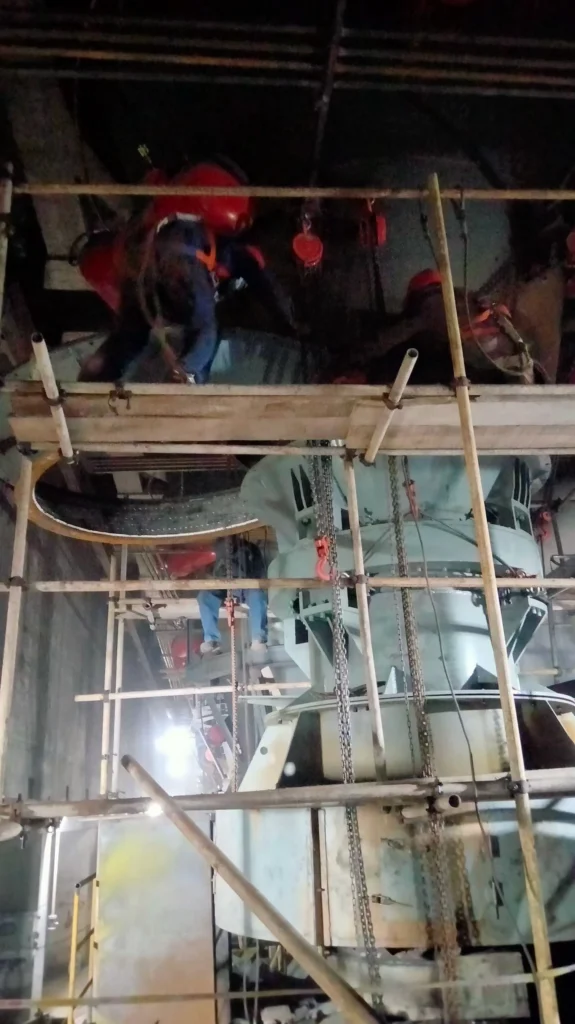
4. Key Points for Retrofitting in the Indonesian Market
Prioritize Preliminary Site Surveys
Conduct site verification of silo materials, dimensions, locations of blockages, material moisture content, and particle composition. Given the significant fluctuations in material moisture during Indonesia’s rainy season, retrofit designs must account for high-humidity and sticky material conditions.
Modular Equipment for Cross-Border Transport and On-Site Assembly
Equipment is shipped in modular sections to suit Indonesian logistics conditions, simplifying the transport of oversized loads (via sea and land) and allowing for on-site assembly and installation.
Sealing and Anti-Corrosion Configuration
To withstand Indonesia’s hot, humid, and saline environment, equipment undergoes anti-corrosion treatment, with reinforced sealing for bearings and drive components to minimize on-site maintenance requirements.
Integration With Existing Plant Control Systems
Depending on project requirements, the equipment can be configured for local operation or integrated with the existing plant control and monitoring system.
5. Benefits of the Retrofit
- Eliminates silo bridging, ratholing, and material buildup on walls, restoring the silo’s full effective storage capacity.
- Can reduce the need for frequent manual cleaning and intervention.
- Ensures continuous material supply to the production line, reducing downtime and production losses caused by blockages.
- Reduce construction costs compared with complete silo reconstruction.
- Ensures stable, low-noise operation with zero dust leakage, meeting plant environmental compliance standards.
Actual performance depends on material properties, silo geometry, operating conditions, and the final equipment configuration.
Conclusion
In many Indonesian industrial plants, existing silos may remain suitable for operation even when recurring material flow problems develop. In such cases, retrofitting the silo can be an alternative to complete reconstruction. Retrofitting existing silos eliminates the need for demolition and reconstruction; by installing specialized mechanical anti-blocking and clearing equipment, the persistent problems of bridging, ratholing, and material buildup can be resolved at the source.
If you operate a power plant, mine, or cement plant in Indonesia and are facing silo blockage issues, please contact us with your silo specifications to receive a customized retrofit proposal and quotation.