
Silo arching, bridging, and ratholing are among the most common and troublesome issues in bulk material handling systems. Among the commonly used solutions for silo blockage and poor material flow, air cannons and silo anti-blocking machines are two options frequently considered by bulk material handling plants: should they choose the air cannon, with its simple structure and flexible installation, or the mechanical anti-blocking machine, which actively breaks arches and ensures continuous flow? Drawing on industry technical data and actual retrofit cases from coal-fired power plants, this article compares these options across four dimensions—working principle, applicable operating conditions, operating costs, and long-term reliability—to assist in your decision-making.
1. Why do silos get blocked?
The phenomena of arching (bridging), wall adhesion, and ratholing in silos are rarely caused by a single factor; rather, they result from the interplay of material properties, silo structure, and storage conditions. Materials such as raw coal often contain moisture and fine particles; under the influence of friction between the material and the silo wall, material arches easily form in the conical section. Materials stored for extended periods become compacted under pressure, leading to an increased internal angle of friction and a significant drop in flowability. Additionally, freezing and adhesion caused by seasonal changes, as well as variations in stickiness when switching coal types, can interrupt material flow. Industry research indicates that over 90% of silo blockages occur within a range of 1 to 2 meters above the outlet, making this specific zone the critical area for anti-blocking measures.
2. Air Cannons: A “Powerful Tool” for Instant Clearing with Inherent Limitations
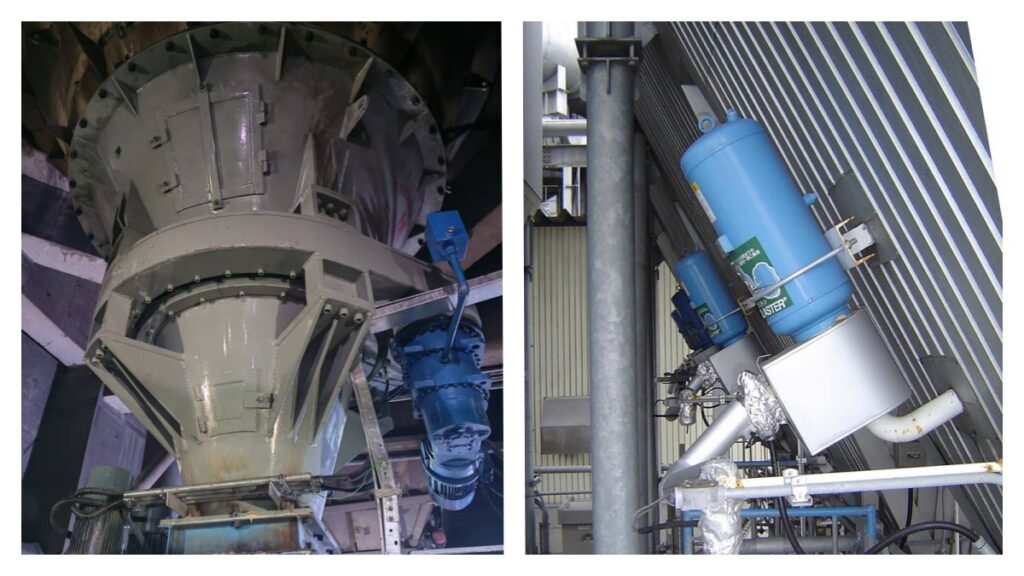
Air cannons are currently among the most widely used blockage-clearing devices. Their working principle involves using compressed air (at 0.4 to 0.6 MPa) as the operating medium; this air is stored in a sealed pressure vessel. When a blockage needs to be cleared, a solenoid valve triggers an instantaneous release, releasing a high-pressure pulse of compressed air into the silo to generate a sudden impact that can loosen or break material buildup and arches. The resulting jet impact and vibration break the static friction of the material, thereby restoring flow. Thanks to their simple structure, lack of moving mechanical parts, ease of installation (requiring only an opening in the silo wall), and low initial investment per unit, they are widely used in industries such as power generation, cement, and chemicals, particularly where compressed air systems are already available on-site. However, the limitations of air cannons are also evident:
- The effective impact area is influenced by the installation location, pressure, silo geometry, and material properties, so multiple air cannons may be required for larger or more complex blockage zones; they are ineffective against highly compacted or strongly cohesive materials.
- They offer a passive, intermittent solution that cannot prevent material arching at the source; discharge rates fluctuate, resulting in unstable material feeding.
- Frequent pressurization and firing consume large amounts of compressed air; higher usage frequency leads to higher operating costs.
- In cold conditions, freezing or increased material cohesion can make blockages more difficult to break, particularly when the material has already become highly compacted.
3. Silo Anti-Blocking Machine: Active, Continuous Mechanical Arch Breaking
A silo anti-blocking machine is a mechanical device designed to prevent and remove material buildup, arching, bridging, and flow restrictions inside silos. Its operating principle involves a clearing assembly driven by a motor: scraper blades rotate 360 degrees along the silo walls, continuously and mechanically cutting and scraping away material adhering to the walls. This eliminates the bonding interface between the material and the wall at the source, ensuring active, consistent material flow. Unlike air cannons, which address blockages only after they occur, the silo anti-blocking machine is a proactive solution designed to prevent blockages from forming in the first place.
Data from actual retrofits at coal-fired power plants confirms its effectiveness. After installing a rotary clearing device on the raw coal silo of a 300 MW unit in 2014, one power plant effectively resolved a long-standing coal blockage problem. Another plant reported significant results following a similar retrofit: the frequency of coal flow interruptions dropped by 58.48%, and auxiliary fuel oil consumption decreased by 76.5%. Regarding equipment capabilities, consider the intelligent variable-tilt vortex-style blockage clearing machine independently developed by Henan Mingyu Wear-Resistant Equipment Co., Ltd.: it performs a full 360-degree sweep of the silo’s inner walls without blind spots, expanding the clearing coverage by more than threefold. Capable of handling materials with specific gravities as high as 4.8, it is suitable for challenging applications such as iron ore, limestone, pellet mix, high-viscosity coal, and sludge silos. It utilizes a high-output torque drive and wear- and corrosion-resistant scrapers; Its variable-inclination design provides greater installation flexibility and can be adapted to different silo geometries and discharge configurations following engineering evaluation, providing an alternative to conventional rotary silo clearing equipment for applications requiring greater installation flexibility. It should be noted that mechanical clearing equipment places high demands on the seal between moving and stationary parts, and the scrapers—being wear parts—require regular inspection and replacement. Although the equipment typically operates continuously, the motor power ranges from only 1.5 to 3 kilowatts, resulting in energy consumption lower than most users anticipate.
4. Core Comparison of the Two Solutions
| Comparison Factor | Air Cannon | Silo Anti-Blocking Machine |
|---|---|---|
| Working Principle | Compressed-air impact | Motor-driven mechanical scraping |
| Operation Mode | Intermittent | Continuous or scheduled |
| Blockage Prevention | Mainly blockage relief | Preventive and corrective |
| Wall Buildup | Depends on impact location | Direct mechanical scraping |
| Energy Source | Compressed air | Electric motor |
| Retrofit | Usually relatively simple | Customized according to silo geometry |
| Maintenance | Valves, seals, pipelines | Drive, scraper, bearings, seals |
| Best Fit | Occasional blockage | Persistent buildup and flow problems |
5. Selection Guide: Matching Solutions to Operating Conditions
There is no single “correct” answer for selection, but you can match the solution to your specific operating conditions:
- When to Use an Air Cannon: Materials with reasonable flowability and only occasional, mild arching; existing compressed air system on-site; limited budget and space for retrofitting.
- When to Use a Silo Anti-Blocking Machine: Materials with high moisture, high adhesiveness, high density, or a tendency to compact (e.g., coal slime, lignite, iron ore concentrate, limestone powder); high requirements for feeding continuity and stability; desire to reduce manual unclogging and downtime losses over the long term.
- When to Consider a Combined Solution: For complex operating conditions, a hybrid mechanical-pneumatic solution can be adopted (e.g., Mingyu’s composite stable feeding and anti-blocking machine). This combines powerful arch-breaking and flow-assisting capabilities, leveraging the strengths of both methods.
Conclusion
For applications involving persistent buildup, cohesive materials, or frequent discharge interruptions, a silo anti-blocking machine may be considered when continuous mechanical assistance and long-term blockage prevention are required.