
Cement plants depend on continuous movement of raw materials and powders through silos, hoppers, chutes, and conveying systems. When material does not discharge properly, the problem can quickly affect feeding, proportioning, grinding, conveying, and overall plant operation.
Cement silo blockage in India is commonly associated with fine powder, moisture, material buildup, compaction, and unfavorable flow conditions. Materials such as raw meal, limestone powder, fly ash, and slag can develop wall buildup, caking, bridging, or ratholing during storage. Similar problems can also occur in cement hoppers and transfer chutes.
For older cement plants, changing material characteristics, higher production requirements, and long-term equipment operation can make existing flow problems more noticeable. Understanding why these blockages occur is important when selecting a practical solution.
1. Common Cement Silo Blockage Problems in India
Cement powder does not always flow uniformly under gravity. Depending on the material and storage conditions, several different flow problems can develop inside a silo.
Wall Buildup and Powder Caking
Fine powder can gradually accumulate on the inner wall of a silo. Moisture can increase adhesion between particles and between the material and the silo wall.
As the deposit becomes thicker, it can reduce the effective cross-sectional area available for material flow. Older deposits may also become compacted and harder to remove.
This is one of the common causes of recurring cement silo blockage.
Bridging and Arching
A bridge or material arch can form above the silo outlet when the powder develops sufficient strength to support itself.
The result can be a silo that appears to contain plenty of material while little or no material reaches the discharge outlet.
Once a stable bridge has formed, normal gravity discharge may not be sufficient to restore flow.
Ratholing and Channeling
Ratholing occurs when material flows mainly through a narrow central channel while material near the silo walls remains stationary.
This creates uneven discharge and leaves a significant amount of material inside the silo. The stagnant material may then compact or cake, making the flow problem more difficult over time.
Hopper and Chute Blockage
The problem is not limited to silos.
Cement plants also handle powders through hoppers and transfer chutes. Material buildup around transitions, restricted sections, or discharge points can reduce the available flow area and eventually cause a blockage.
A blockage at one point can interrupt material movement through downstream equipment.
2. Why Does Cement Silo Blockage Occur in India?
There is usually no single cause of a silo blockage. Material characteristics, moisture, silo geometry, storage conditions, and existing flow-aid equipment can all contribute to the problem.
2.1 Moisture and India’s Monsoon Conditions
Moisture is an important consideration for fine powder handling.
Many regions of India experience seasonal monsoon conditions with high humidity and significant rainfall. If moisture enters a cement powder handling system, the flow characteristics of the material may change.
Fine powders can become more cohesive, increasing the possibility of wall adhesion, caking, and compaction.
The impact varies between plants because different materials, storage systems, and operating conditions are involved. However, moisture should be considered when investigating recurring cement silo blockage in India.
2.2 Fine Powder and Material Flow Characteristics
Raw meal, fly ash, limestone powder, slag, and other cement-related materials can contain a high proportion of fine particles.
Fine particles have a large surface area relative to their mass and can develop significant inter-particle forces. Under prolonged storage, the material can become compacted and may not discharge evenly.
Changes in particle size, moisture content, bulk density, and material composition can also change flow behavior.
This is why the same silo may behave differently when the material properties or operating conditions change.
2.3 Silo Geometry and Outlet Design
Silo geometry plays an important role in material flow.
The hopper angle, outlet size, wall surface, transition design, and position of the discharge equipment can all influence how material moves toward the outlet.
If the flow pattern leaves stagnant areas near the walls, material can gradually accumulate in these locations. Once buildup becomes significant, it can contribute to bridging, ratholing, or restricted discharge.
This is particularly relevant for older installations where the original silo design may no longer match current production conditions.
2.4 Long Storage Time and Material Compaction
The longer powder remains inside a silo, the greater the opportunity for compaction and buildup to develop.
This can become a problem when material consumption is lower than expected, production is interrupted, or the silo is used as a buffer for an extended period.
Compacted material can have different flow characteristics from freshly stored powder and may require additional mechanical assistance to discharge.
2.5 Limitations of Conventional Flow-Aid Equipment
Many cement plants use air cannons, vibrators, or manual cleaning to deal with flow problems.
These methods can be useful in specific situations, but they do not work equally well for every type of blockage.
An air cannon can provide a strong local impact, but its effectiveness may be limited when the problem involves thick wall buildup or compacted powder.
A vibrator can assist material movement, but vibration alone may not remove an established layer of material attached to the silo wall.
Manual cleaning can restore flow after a severe blockage, but it requires labor and may involve shutdowns, dust exposure, work at height, or confined-space work depending on the equipment and cleaning procedure.
As a result, recurring blockages may continue even when conventional flow aids are already installed.
3. How Cement Silo Blockage Affects Plant Operation
A blockage in a cement silo is not always an isolated storage problem. Because silos are connected to other parts of the production process, an interruption in material discharge can affect the wider production line.
Unstable Material Feeding
When material does not discharge at a consistent rate, the downstream feeding system may receive an irregular supply.
For proportioning systems, unstable material flow can make it more difficult to maintain consistent feeding conditions.
Production Interruptions
A severe blockage may restrict material supply to grinding, conveying, or other downstream equipment.
If operators need to stop equipment to remove the blockage, production time can be lost and maintenance requirements can increase.
Material Accumulation
When a silo does not discharge evenly, material may remain in stagnant areas.
Over time, this reduces the usable storage volume and can make subsequent discharge more difficult.
Increased Maintenance and Safety Risks
Repeated manual clearing increases maintenance workload.
Depending on the silo or hopper configuration, blockage removal may require workers to operate at height or enter restricted areas. Dust and falling material can also create additional safety concerns.
For plants dealing with recurring cement silo blockage in India, reducing the frequency of manual intervention can therefore be an important operational objective.
4. Solutions for Cement Silo Blockage in India
The appropriate solution depends on the actual blockage mechanism.
Before selecting equipment, factors such as material properties, moisture, silo dimensions, outlet size, capacity, blockage location, and existing flow-aid systems should be considered.
For recurring wall buildup, bridging, ratholing, and uneven discharge, mechanical flow assistance can provide an alternative to relying only on external vibration or air impact.
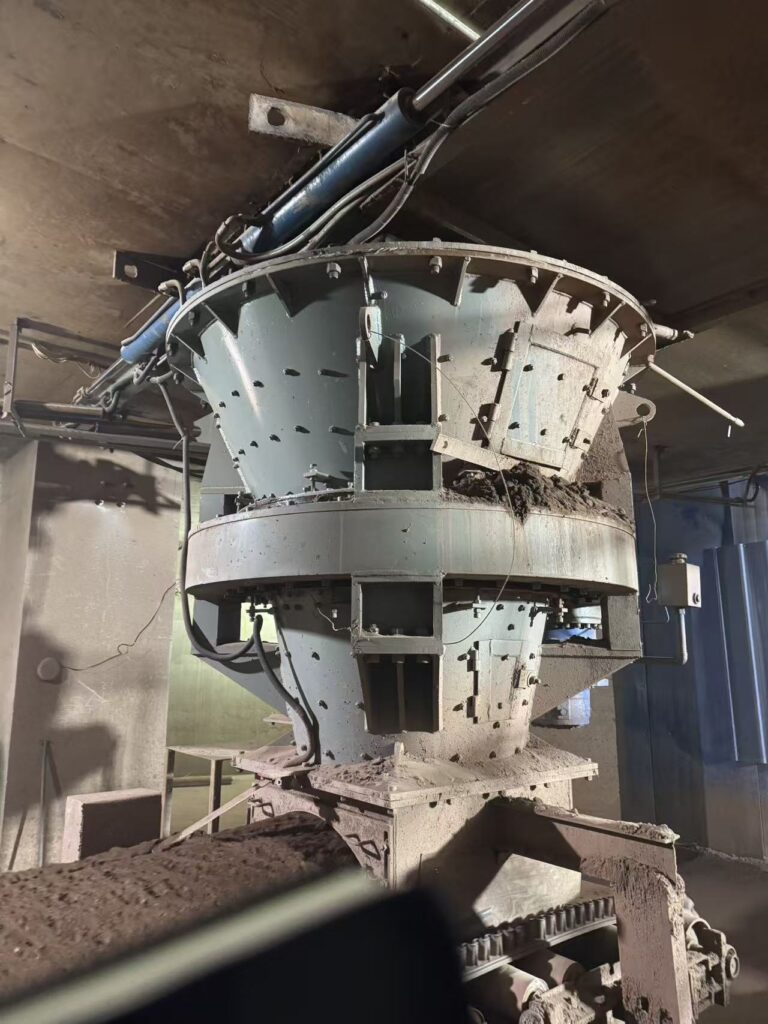
Intelligent Variable Inclination Vortex Anti-Blocking Machine
HNMY’s Intelligent Variable Inclination Vortex Anti-Blocking Machine is designed for mechanical flow assistance inside existing silos and hoppers.
The equipment uses a rotating scraper with a variable inclination. The scraper can rotate 360° along the inner wall and mechanically interact with material in areas where buildup or stagnant material may develop.
Mechanical Removal of Wall Buildup
The rotating scraper works near the silo wall to disturb accumulated powder.
Regular mechanical movement can help reduce the formation of thick deposits and maintain more available space for material flow.
This is particularly relevant where conventional external flow aids have difficulty reaching material attached directly to the silo wall.
Assistance Against Bridging
The mechanical movement also disturbs material inside the silo.
Depending on the material and silo configuration, this can help interfere with the development of stable arches and reduce the tendency of material to remain stationary above the outlet.
Reducing Ratholing and Stagnant Zones
When material flows mainly through the center of a silo, powder near the wall can remain stagnant.
The variable-inclination scraper provides mechanical movement near these areas and can help bring stagnant material back into the active flow zone.
The objective is to promote more consistent material movement rather than relying solely on a central flow channel.
Retrofit for Existing Cement Silos
One important application is the retrofit of existing silos.
The system can be configured according to the existing silo dimensions, outlet arrangement, material characteristics, and installation conditions. This makes it suitable for cement plants looking to improve the performance of an existing silo rather than replace the entire storage structure.
The equipment can be considered for:
- Raw meal silos
- Fly ash silos
- Slag powder silos
- Cement powder silos
- Proportioning hoppers
- Material transfer chutes
Automatic Operation
The system can support scheduled operation, automatic start/stop control, and linkage with production-line signals according to the project configuration.
This allows the equipment to provide regular flow assistance with less dependence on manual blockage clearing.
5. Application Value for Indian Cement Plants
For cement plants dealing with recurring cement silo blockage, a proactive flow-assistance approach can provide several operational advantages.
More Stable Powder Discharge
Regular mechanical flow assistance can help maintain material movement and reduce the accumulation of powder in stagnant areas.
Reduced Wall Buildup
Mechanical scraping near the silo wall can help control material deposits before they become large and difficult to remove.
Less Manual Cleaning
If recurring buildup and blockage can be reduced, operators may have less need to rely on manual clearing.
Reduced Downtime
More stable discharge can help reduce production interruptions associated with silo and hopper blockages.
Retrofit Existing Equipment
A retrofit approach allows cement plants to improve existing silos and hoppers without necessarily replacing the complete storage system.
The actual results depend on material properties, silo structure, operating conditions, and equipment configuration. A site-specific assessment is therefore important before selecting the final solution.
Conclusion
Cement silo blockage in India can result from several factors, including fine powder characteristics, moisture, material compaction, silo geometry, long storage periods, and limitations of existing flow-aid equipment.
Wall buildup, caking, bridging, ratholing, hopper blockage, and chute blockage can interrupt material discharge and affect the stability of cement production.
Air cannons, vibrators, and manual cleaning can provide assistance in certain situations, but recurring flow problems may require a more targeted mechanical approach.
HNMY’s Intelligent Variable Inclination Vortex Anti-Blocking Machine uses a 360° variable-inclination rotating scraper to provide mechanical flow assistance inside existing silos and hoppers. It can help address wall buildup, stagnant zones, bridging, ratholing, and uneven discharge in applications involving cement powders and other fine bulk materials.
For cement silo blockage in India, the equipment configuration should be selected according to the material characteristics, silo dimensions, outlet size, capacity, blockage location, and existing flow conditions.
Related solution:Silo and Hopper Blockage Solutions for India’s Power, Cement and Mining Industries