
Coal bunker blockage is a universal and troublesome problem for thermal power plants, coal chemical and metallurgical enterprises. Frequent bridging, rat-holing and wall adhesion will lead to unstable coal feeding, intermittent production and unnecessary shutdown losses. Only by figuring out the root causes of coal bunker blockage can we select matching anti-blocking equipment, including Intelligent Variable Inclination Vortex Anti-Blocking Machine, rotary silo blockage cleaning machine and chute blockage cleaning machine, to achieve long-term smooth blanking.
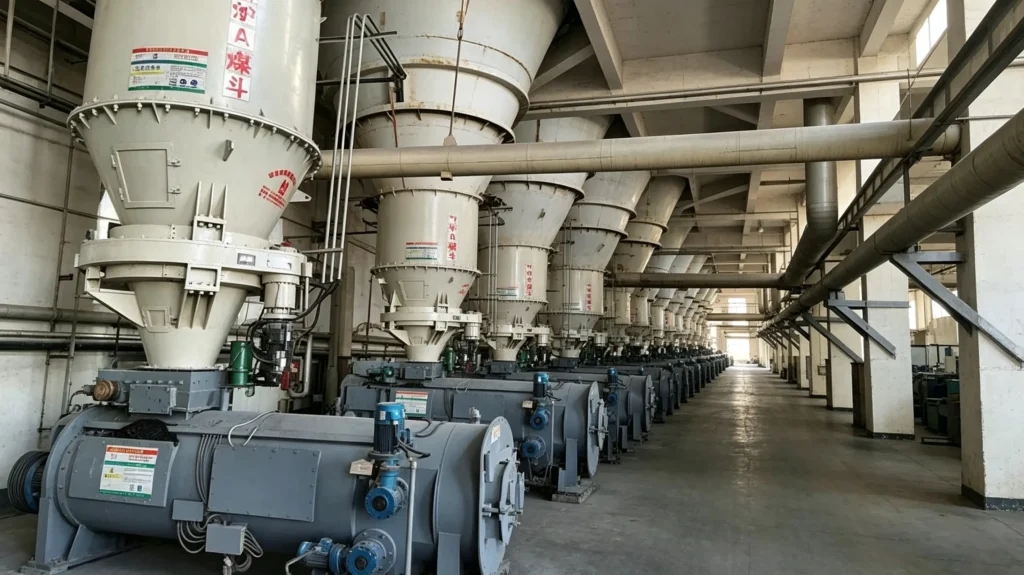
1. High Moisture Content Increases Coal Viscosity and Causes Coal Bunker Blockage
Raw coal with high water content easily becomes sticky. Coal particles adhere to one another and stick firmly to the inner wall of the silo. As sticky coal accumulates continuously, the flow channel gradually narrows. This is the most common cause of coal bunker blockage for power plants operating in humid environments. Silo wall flow aid equipment can reduce wall adhesion, while vortex anti-blocking machines clear accumulated coal regularly.
2. Unreasonable Silo Structural Design
Rectangular tapered bunkers form dead coal zones at internal corners. Conical bunkers see rising material extrusion pressure and declining flow force during blanking. Even hyperbolic bunkers cannot completely avoid coal arching when transporting viscous coal. Different silo structures need targeted anti-blocking schemes instead of universal simple solutions to avoid coal bunker blockage.
3. Extrusion Compaction Forms Stable Coal Arches
When raw coal flows downwards, the pressure from upper coal piles compacts materials at the silo outlet. Compacted coal forms hard, stable arches that stop subsequent coal from falling. Traditional manual dredging is inefficient and unsafe. Rotary silo blockage cleaning machine can continuously break coal arches and prevent arch reconstruction to eliminate coal bunker blockage.
4. Mixed Particle Size Causes Material Segregation
When large lump coal and fine coal powder are mixed unevenly, particle segregation occurs inside the silo. Fine powder fills gaps between large coal lumps, forming dense structures with poor fluidity. Material segregation easily triggers rat-hole blockage. Timely disturbance by vortex anti-blocking equipment helps maintain uniform material flow and avoid coal bunker blockage.
5. Long-term Accumulation of Residual Coal on Silo Walls
Without regular cleaning, residual coal slowly hardens on silo inner walls. The changed wall inclination worsens coal flow conditions and accelerates subsequent blockage. Continuous scraping equipment such as chute blockage cleaning machine removes residual coal and keeps the original silo flow geometry to prevent coal bunker blockage.
6. Improper Operation and Supporting Equipment Matching
Mismatched coal feeders, gate valves and unreasonable blanking control will aggravate silo blockage. The electro-hydraulic slide gate valve can control discharging speed stably. When matched with anti-blocking machines, it forms a complete system to avoid sudden pressure changes inside the silo, which is an effective way to reduce coal bunker blockage.
The best anti-blocking strategy combines cause analysis and matched equipment configuration. If your site suffers from repeated coal bunker blockage, we can provide customized schemes combining Intelligent Variable Inclination Vortex Anti-Blocking Machine, silo flow aid equipment and chute cleaning devices. Contact our technical team for professional solutions according to your raw coal properties and silo structure.