
Choosing the right silo scraper configuration is not simply a matter of silo size. Silo diameter, cone geometry, material characteristics, blockage-prone areas, required coverage, drive torque, and installation conditions all influence the scraper configuration.
1. The Role of Scrapers in Silo Anti-Blocking Machines
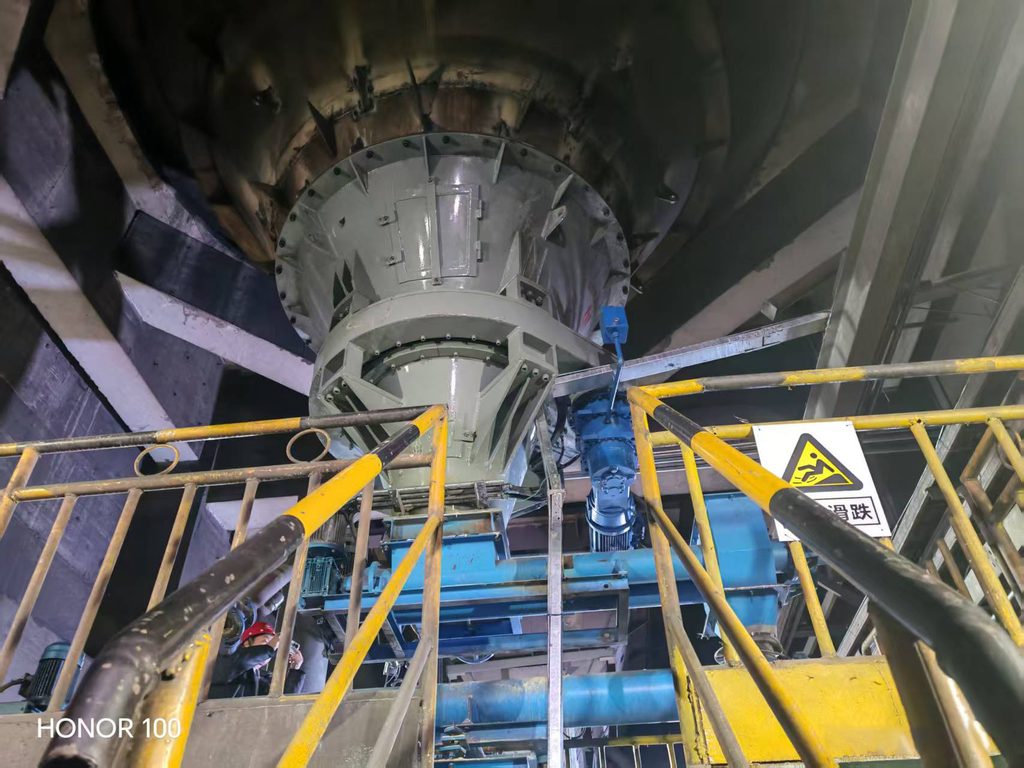
The clearing assembly of the rotary anti-blocking machine rotates 360 degrees along the silo wall, driving the scrapers to continuously and mechanically cut and scrape material adhering to the wall. This action disrupts the bond between the material and the silo wall, achieving the dual effects of breaking material arches and removing wall-adhered material. Scrapers are wear parts; their quantity and arrangement directly determine the clearing coverage area of a single unit and whether clearing can be achieved without blind spots across different zones—such as the upper and middle sections of the silo cone and the coal feeder inlet.
2. What Determines the Number of Silo Scrapers?
- Silo Diameter and Cone Coverage Area. The scraper’s function is to cover the entire cone area; therefore, the larger the silo diameter and cone area, the greater the number and length of scrapers or scraper arms required. The effective scraper working diameter should be selected according to the silo outlet, cone geometry, and required blockage-clearing coverage. Taking the three models of Mingyu rotary anti-blocking machines as examples, the upper silo interface diameter increases in stages—from 1000–1500 mm to 1500–2000 mm, and finally to 2000–3000 mm—with the corresponding motor power increasing accordingly.
- Material Characteristics (Viscosity, Moisture Content, Adhesiveness, Specific Gravity). The higher the material’s viscosity, moisture content, and adhesiveness, the greater the need for more scrapers and increased scraping force. Industry selection guidelines suggest the following: for sticky or high-moisture materials, multi-arm or spiral scrapers equipped with wear-resistant alloy components should be selected; for highly cohesive lignite or high-moisture washed blended coal, priority should be given to heavy-duty blockage clearing machines featuring a higher number of scrapers and greater rotational torque; conversely, for light, fine powders with good flowability, a single-arm configuration with polyurethane scrapers is sufficient.
- Blockage clearing coverage height and zoning of stationary and rotating blades. Rotary blockage clearing machines are typically installed in the section prone to clogging between the silo outlet and the coal feeder inlet (this is typically one of the most blockage-prone areas); they must cover the entire height of this prone zone, from the upper part of the silo cone to the bottom. Consequently, mainstream equipment generally employs a zoned layout of stationary and rotating blades—for instance, arranging three scrapers vertically (top, middle, and bottom), with rotating blades at the top and bottom and a stationary blade in the middle. These correspond to the upper loose zone and the lower compacted zone, respectively, with differentiated scraper angles and materials to eliminate any “dead zones” in the clearing process.
- Drive capability (torque and power). The greater the number of scrapers and the stickier or heavier the material, the higher the requirements for the drive system’s torque and power. As scraper load and material resistance increase, the drive system must provide sufficient torque to maintain stable rotation under working conditions. Models with multiple scrapers require high-torque gear reducers and more powerful drive assemblies; otherwise, they would struggle to drive the heavily loaded scrapers to clear blockages effectively.
- Installation space and coordination with downstream equipment. The equipment is positioned between the raw coal silo outlet and the coal feeder inlet; the scraper configuration must align with the coal feeder, the slide gate valve, and downstream processing capacity. For example, when it is necessary to cover the bottleneck section at the coal feeder inlet, a lower rotating blade is often added, extending into the area just above the inlet. The equipment height must cover the blockage-prone zone while accounting for operational constraints such as slide gate valve interlocking and explosion-proof requirements. Higher processing capacities and larger downstream equipment specifications necessitate more extensive blockage clearing coverage and optimized scraper layouts.
3. Why “More Scrapers” Is Not Necessarily Better
Increasing the number of scrapers comes at a cost: more scrapers require higher torque and power, result in greater energy consumption and manufacturing costs, and increase the number of wear parts requiring regular inspection and replacement. If the material properties do not necessitate a large number of scrapers, blindly increasing the count will only drive up procurement and O&M costs. Furthermore, improper arrangement of stationary and rotating blades can create “dead zones” where material accumulates; long-term buildup exacerbates scraper wear and can even lead to blade detachment. Therefore, the optimal solution is to match the number of scrapers to the material properties, coverage area, and drive capacity. Advanced equipment designs—such as external scraper mounting, labyrinth seals, and 360-degree rotation without dead zones—are used to eliminate accumulation points and simplify maintenance.The goal is not to maximize the number of silo scrapers, but to achieve the required clearing coverage with an appropriate scraper configuration.
4. How to Determine the Required Silo Scraper Configuration
Determining the scraper count is essentially a customization process based on specific operating conditions. Key inputs typically include:
- Silo parameters: Silo diameter, cone angle, cone height, and the vertical range of the section prone to blockage;
- Material parameters: Analytical data such as moisture content, viscosity, specific gravity, cohesiveness, and particle size;
- Operational requirements: Throughput capacity, specifications of downstream coal feeders and slide gate valves, and whether sludge or coal slime is co-fired;
- Installation constraints: Available installation space, explosion-proof rating, maintenance access, etc. Pproviding these operating conditions to the equipment manufacturer allows engineers to select a customized configuration based on the product structure, ensuring the scraper setup is perfectly matched to your silo and material.
5. Silo Scraper Selection: What Information Should You Provide?
Before selecting a silo scraper system, the manufacturer typically needs the silo diameter, cone geometry, material properties, blockage location, required throughput, and available installation space.
For existing silo retrofit projects, HNMY (Henan Mingyu) evaluates these operating conditions to determine the appropriate scraper arrangement, scraper material, drive capacity, and installation configuration.
Providing silo drawings, material information, photos, or videos of the blockage condition can help HNMY engineers develop a configuration matched to your specific application.
Conclusion
There is no single “standard answer” regarding the number of scrapers for a silo anti-blocking machine; rather, the configuration is the result of a complex interplay between factors such as silo diameter and coverage area, material properties, the zoning of stationary and rotating blades, drive capacity, and coordination with downstream equipment. By understanding these determining factors, communicating operating conditions thoroughly with the manufacturer, and selecting a scraper configuration matched to the material and silo type, you can achieve effective, long-term, stable, and low-maintenance blockage prevention.The goal of silo scraper selection is not to maximize the number of scrapers, but to achieve the required clearing coverage and scraping force with an appropriately matched configuration.