
In India’s thermal power plants, fly ash handling is an important part of plant operation. Dry fly ash is collected, stored, and transported through a series of equipment, with the fly ash silo serving as an important storage and discharge point.
The performance of the silo discharge system directly affects the continuity of ash handling. However, fly ash discharge problems can occur when fine ash is affected by moisture, compaction, storage conditions, or unfavorable flow patterns.
Common problems include wall adhesion, caking, arching, bridging, ratholing, channeling, and intermittent discharge. When these problems become severe, fly ash may accumulate inside the silo and interfere with the normal operation of the ash handling system.
This article discusses the main causes of fly ash discharge problems in Indian thermal power plants and the approaches that can be considered to improve fly ash flow and discharge.
Related solution:Silo and Hopper Blockage Solutions for India’s Power, Cement and Mining Industries
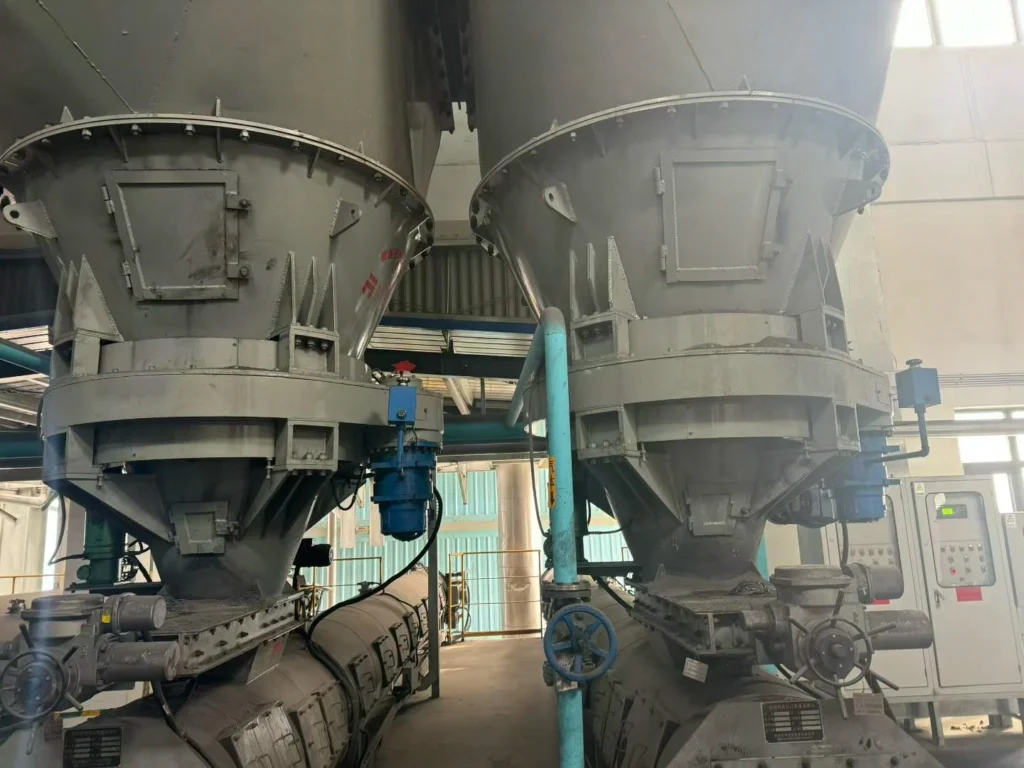
1. Common Fly Ash Discharge Problems in Indian Thermal Power Plants
Fly ash consists mainly of fine particles and can have different flow characteristics depending on its composition, fineness, moisture content, and storage conditions.
Because of its fine particle size, fly ash can be sensitive to moisture and compaction during storage. When flow conditions are unfavorable, several types of discharge problems may develop.
One common problem is wall adhesion and caking. Fly ash can accumulate on the inner wall of a silo and gradually form a thicker layer. If moisture is present, the deposited material may become more cohesive and harder to remove.
Another common problem is arching and bridging. A stable arch can form above the discharge outlet, preventing material from reaching the outlet even though the silo still contains a significant amount of fly ash.
Ratholing and channeling can also occur. In this situation, fly ash flows mainly through a central passage while material around the flow channel remains relatively stationary. The result can be an unstable discharge rate and an increasing amount of stagnant material inside the silo.
These conditions are typical forms of fly ash discharge problems and can make it difficult to maintain consistent ash flow through the handling system.
2. Core Causes of Fly Ash Silo Blockages and Discharge Issues in Indian Power Plants
1. Tropical, High-Humidity Climate Can Increase Moisture-Related Problems
Environmental conditions can have a significant influence on fly ash flow.
Many regions of India experience seasonal monsoon conditions with periods of high humidity and rainfall. Where fly ash is exposed to moisture during storage or handling, its flow characteristics may change.
Because fly ash consists of very fine particles, moisture can increase particle adhesion and promote agglomeration. Damp material may stick to the silo wall or form compacted deposits, making subsequent discharge more difficult.
However, climate is not the only factor involved. The severity of a fly ash discharge problem also depends on ash properties, silo design, storage time, and the condition of the discharge system.
2. Fine Particle Characteristics Can Affect Flowability
Fly ash is a fine powder, and its flow behavior can vary according to particle size distribution, moisture content, bulk density, and composition.
During prolonged storage, the material can become compacted. Fine particles may also accumulate in stagnant areas of the silo instead of moving evenly toward the outlet.
Variations in the coal used by a power plant can also result in changes in the characteristics of the fly ash produced. Differences in fineness and composition may therefore affect how the ash behaves during storage and discharge.
When these factors combine with an unfavorable flow pattern, problems such as wall buildup, bridging, ratholing, and intermittent discharge may develop.
3. Limitations of Conventional Ash Removal and Unblocking Methods
Fly ash silos are commonly equipped with gravity discharge systems and may also use air cannons, vibrators, or other flow aids.
These methods can provide useful assistance in certain applications, but their effectiveness depends on the type and location of the flow problem.
An air cannon can disturb material around a blockage, but its effect may be limited when fly ash has formed a thick or hardened layer on the silo wall.
Vibration can help promote material movement in some conditions, but it may not be sufficient to remove established buildup or compacted material.
Manual cleaning can restore discharge when a severe blockage occurs, but it requires additional labor and may require the equipment or system to be taken out of service. It can also expose workers to dust, falling material, work-at-height conditions, or confined-space hazards depending on the cleaning procedure.
For recurring fly ash discharge problems, repeatedly clearing the blockage does not necessarily prevent the same problem from occurring again.
3. Impact of Fly Ash Discharge Failures on Indian Power Plant Operations
Poor fly ash discharge can affect the normal operation of the ash handling system.
When fly ash cannot leave the silo at the required rate, material may continue to accumulate inside the storage system. If the problem persists, it can place additional pressure on downstream conveying and discharge equipment.
Unstable discharge can also make it more difficult to maintain a consistent ash transport rate.
For power plants that handle large quantities of fly ash, repeated discharge interruptions may result in:
- Increased operator intervention
- Additional cleaning and maintenance
- Reduced equipment availability
- Delays in ash handling
- Higher O&M requirements
Manual blockage removal also introduces additional safety considerations, particularly where workers need to access elevated areas or confined spaces.
For this reason, improving the reliability of fly ash discharge is an important part of maintaining a stable ash handling system.
4. High-Efficiency Prevention Solution for Fly Ash Silo Blockages in Indian Thermal Power Plants
For recurring fly ash discharge problems, the solution should be selected according to the ash characteristics, silo geometry, blockage location, and existing flow-assisting equipment.
HNMY’s Intelligent Variable Inclination Vortex Anti-Blocking Machine provides a mechanical approach to assisting material flow inside existing silos.
The equipment can be configured for different silo applications and is designed to work directly with material near the silo wall and other areas where stagnant material may accumulate.
360° Variable-Angle Vortex Sweeping
The system uses a 360° rotating scraper with variable inclination.
As the scraper moves along the silo wall, it mechanically disturbs accumulated fly ash and helps reduce the buildup of material in areas that are difficult to reach through conventional external flow aids.
This can help with problems such as:
- Wall buildup
- Material caking
- Stagnant zones
- Bridging
- Ratholing
- Uneven discharge
Rather than waiting for a severe blockage to develop, the system can provide regular mechanical flow assistance according to the operating requirements of the silo.
Automated Operation
The system can support scheduled operation, automatic start/stop control, and linkage with the existing ash handling system according to the project configuration.
This allows the equipment to provide regular flow assistance with less manual intervention.
For power plants experiencing recurring fly ash discharge problems, automated mechanical flow assistance can help reduce the frequency of manual blockage clearing and support more consistent silo discharge.
5. Application Value
Compared with methods that are mainly used after a blockage has already occurred, a mechanical anti-blocking system focuses on reducing material accumulation and maintaining material movement.
For Indian thermal power plants, this approach can be considered where high humidity, fine fly ash, storage conditions, or silo geometry contribute to recurring discharge problems.
Potential benefits include:
- More consistent fly ash discharge
- Reduced wall buildup
- Fewer manual cleaning operations
- Lower maintenance intervention
- Reduced downtime associated with recurring blockage
- Improved operating safety
The actual performance depends on the characteristics of the fly ash, silo design, operating conditions, and equipment configuration. Therefore, each fly ash discharge problem should be evaluated based on the specific conditions of the plant.
Conclusion
Fly ash discharge problems in Indian thermal power plants can be caused by a combination of fine particle characteristics, moisture, storage conditions, compaction, silo geometry, and unfavorable flow patterns.
Wall adhesion, caking, bridging, ratholing, and intermittent discharge can all reduce the reliability of fly ash silo operation.
Air cannons, vibrators, and manual cleaning can be useful in certain applications, but recurring problems may require a more targeted flow-assisting approach.
For a fly ash discharge problem, the appropriate solution should be evaluated according to fly ash characteristics, silo dimensions, outlet size, handling capacity, blockage location, and existing flow-aid equipment.