
Indonesia’s mining sector dominates domestic resource output, handling coal, nickel, copper and bauxite at scale. Every mine site runs continuous bulk material cycles across crushing, screening, silo storage and conveyor transfer systems.
Any disruption in material flow cascades rapidly through the entire processing line. Ore may accumulate inside bins, stick to hopper walls, build up in transfer chutes, or discharge unevenly from storage equipment. Unresolved mining material flow problems lower plant throughput and drastically increase routine maintenance burdens.
Indonesia’s tropical climate creates harsh handling conditions for bulk ore materials. High humidity, seasonal rainfall, changes in ore moisture, and variations in fines content can all affect how ore behaves during storage and transfer. Wet or highly cohesive material is more likely to stick to internal surfaces, form buildup, or become difficult to discharge.
For this reason, a practical approach to material flow starts with the ore itself, then considers the equipment, transfer arrangement, and actual operating conditions at the site.
Common Material Flow Problems in Indonesian Mining Operations
1. Wet Ore and Fine Particles Causing Material Adhesion
Ore moisture can change during mining, stockpiling, transportation, and processing.
During Indonesia’s wet season, exposed ore can pick up additional moisture before reaching the processing plant. Fine particles can hold this moisture and become more cohesive, making them more likely to stick to equipment surfaces.
Once wet ore enters a bin, hopper, or transfer chute, operators may start to see:
- Material sticking to internal walls
- Fine-particle buildup
- Wet material caking
- Reduced discharge rates
- Localized areas of stagnant material
The behavior depends heavily on the type of ore. Nickel ore, laterite ore, bauxite, and other fine-grained minerals can respond differently to changes in moisture content.
This is why equipment dimensions alone are not enough when investigating a flow problem. Particle size, moisture content, bulk density, and material cohesiveness should also be considered.
2. Stagnant Material Inside Bins and Hoppers
Mining bins and hoppers are designed to handle large quantities of ore, but material rarely moves uniformly across the entire bin volume.
If the equipment geometry does not suit the material being handled, some areas can remain relatively inactive while material near the outlet continues to discharge.
Typical signs include:
- Ore accumulating along hopper walls
- A stable layer forming above the outlet
- Material discharging mainly through the center
- Surrounding material remaining stationary
- Localized flow channels or ratholing
- Large quantities of residual material left inside the bin
Apart from reducing usable storage volume, stagnant material can become harder to move after prolonged storage. Pressure from the material above it and changes in moisture can further compact the ore.
3. Material Buildup and Blockage in Transfer Chutes
Transfer chutes are another common source of flow problems in mining plants.
After crushing, screening, or conveying, ore has to pass through a series of transfer points before reaching the next process stage. If wet material or a high proportion of fines enters the chute, buildup can gradually develop on the chute walls.
Common problems include:
- Ore sticking to chute walls
- Buildup around transfer points
- Restricted material passage
- Irregular discharge
- Localized chute blockage
A blocked transfer chute can have consequences beyond the transfer point itself. If material cannot pass through, upstream conveyors may have to stop, affecting crushing, screening, or downstream mineral processing.
4. Changes in Ore Properties
Ore characteristics at Indonesian mines shift constantly throughout production cycles.
Ore sources may change, material from different mining areas may be blended, and the proportion of fines or moisture may vary from one production period to another.
For example:
- Ore may come from a different mining area
- Different ore grades may be blended
- Fine-particle content may increase
- Moisture may rise during the rainy season
- Material behavior may differ between wet and dry periods
A bin, hopper, or chute that previously operated without problems may begin to show unstable discharge after these changes.
The equipment has not necessarily failed. The material being handled may simply no longer behave in the same way as it did when the system was originally designed.
5. Equipment Wear After Long-Term Mining Operations
Mining equipment operates under continuous impact and abrasion. Long‑term abrasion and impact gradually degrade internal liner surfaces and destroy original flow conditions.
Typical signs of wear include:
- Worn liners
- Rough internal surfaces
- Localized deformation
- Damaged material-guiding components
A surface that was relatively smooth when new may become rough after years of contact with abrasive ore. Friction between the material and the equipment can increase, creating locations where ore begins to slow down and accumulate.
As a result, some mining material flow problems develop from a combination of changing material properties and equipment condition rather than from a single cause.
How to Improve Bulk Material Flow in Mining Operations
No one-size-fits-all solution eliminates mining flow issues. Remedies must adapt to ore type, moisture level, equipment geometry and actual blockage patterns.
1. Start With the Actual Ore Characteristics
Before changing the equipment, first determine how the material behaves under actual operating conditions.
Useful parameters include:
- Ore type
- Particle size distribution
- Fines content
- Moisture content
- Bulk density
- Cohesiveness
- Tendency to form lumps or agglomerates
The same bin or hopper can perform differently when handling different ore types. A change in moisture or fines content alone may be enough to alter the flow pattern.
2. Identify Where Material Is Actually Accumulating
A flow problem should be investigated at the point where it occurs rather than treating the entire system as one blockage.
Site inspections should look for:
- The initial location of material buildup
- Dead zones with little material movement
- Blockages near discharge outlets
- Persistent buildup inside chutes
- Locations where the same problem occurs repeatedly
Knowing the exact accumulation point can help determine whether the issue is related to equipment geometry, material properties, surface condition, or operating practice.
It also helps avoid adding vibration equipment or enlarging an outlet without first understanding the underlying problem.
3. Modify Existing Equipment Where Practical
Large mining bins, hoppers, and transfer systems are not easy to replace. Full structural reconstruction involves high costs, heavy engineering workloads and lengthy production downtime.
If the main structure remains suitable for service, a targeted modification may be a more practical option.
Depending on the site, this may include:
- Replacing heavily worn liners
- Improving internal wall surfaces
- Modifying material-guiding sections
- Optimizing the discharge area
- Adding mechanical flow-aid equipment
The modification should focus on the area causing the flow problem rather than changing the entire system unnecessarily.
4. Consider Active Mechanical Flow-Aid Equipment
For bins and hoppers suffering chronic stagnant ore and wall buildup, active mechanical flow-aid equipment delivers reliable on-site improvement.
External vibration and impact devices act on the equipment structure. Mechanical flow-aid systems, in comparison, can work directly in the material flow area and disturb material that tends to remain stationary.
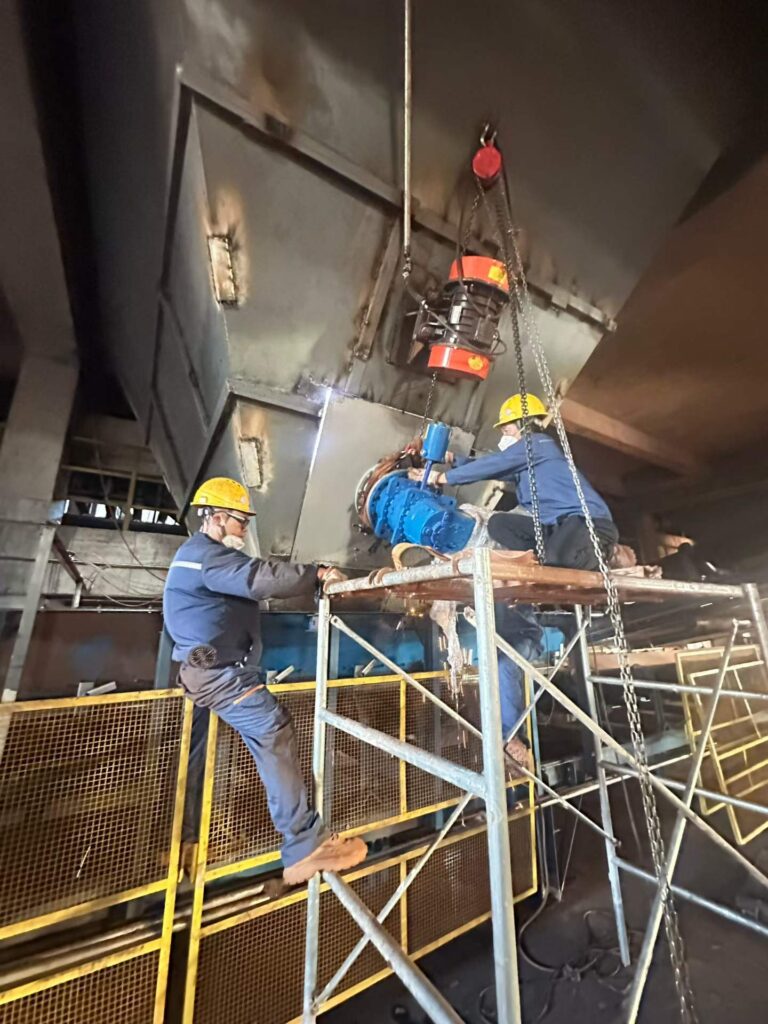
HNMY’s Silo Wall Flow-Assisting Blockage Removal Device is designed to improve material flow along silo walls and reduce material adhesion, buildup and poor discharge in ore and mineral storage bins.
For existing mining facilities, the equipment can be configured according to the existing silo structure, material characteristics and buildup conditions. It can be applied to retrofit existing bins without requiring complete replacement or major structural reconstruction.
Equipment selection should consider:
- Ore or mineral type and particle characteristics
- Moisture content and material adhesion
- Silo dimensions and wall structure
- Location and extent of material buildup
- Material discharge arrangement and flow requirements
- Required flow-assisting and blockage removal area
The appropriate configuration depends on the actual material properties, silo structure and material flow conditions and should be evaluated on a case-by-case basis.ation depends on the actual site conditions and should be evaluated on a case-by-case basis.
5. Pay Attention to Wet-Season Operating Conditions
For mines in Indonesia, changes during the rainy season deserve particular attention.
Operators can track:
- Changes in ore moisture
- Changes in fines content
- Buildup after wet ore enters storage bins
- Material accumulation in transfer chutes
- Seasonal changes in discharge performance
Comparing these conditions over time can help determine whether recurring flow problems are associated with moisture, ore characteristics, or equipment conditions.
Retrofitting Existing Bins and Transfer Systems at Indonesian Mines
Many Indonesian mining operations have bins, hoppers, chutes, and conveyor systems that have been operating for years.
When material buildup or blockage becomes frequent, replacing the complete system is not always necessary. If the main structure is still serviceable, the problem area can be assessed and modified separately.
Before planning a retrofit, the following information should be reviewed:
- Equipment dimensions
- Ore type
- Particle size
- Moisture content
- Buildup location
- Discharge method
- Existing flow-aid equipment
- Required production capacity
This information helps determine whether the best approach is to modify the equipment structure, improve a specific flow area, or install mechanical flow-aid equipment.
For Indonesian mining projects, targeted retrofit work can also reduce the amount of structural modification required and help keep shutdown time under control.
Impact of Material Flow Problems on Mining Production
Material flow problems may begin at a single bin, hopper, or chute, but their effects can extend into the wider processing system.
Recurring problems can lead to:
- Crushing system interruptions
- Conveyor shutdowns
- Reduced downstream throughput
- Lower effective storage capacity
- More frequent manual cleaning
- Increased maintenance work
- Higher risk of unplanned downtime
Improving bulk material flow is therefore not simply about clearing one blockage. The objective is to keep ore moving reliably from one stage of the mining process to the next.
Conclusion
Mining material flow problems in Indonesian sites stem from variable ore properties, tropical humidity, seasonal wet ore, liner wear and outdated flow geometry. Unlike stable coal or cement powder, mine ore changes constantly in fineness and cohesion, making generic flow solutions ineffective.
Instead of full equipment replacement, targeted retrofits and mechanical anti-block systems resolve stagnation and buildup at the source. Optimized material handling stabilizes ore flow across crushing, conveying and transfer systems, minimizing manual cleaning and unplanned downtime.