
Cement powder and fly ash are widely used in Vietnam’s cement, concrete, and building material industries. Under normal conditions, these fine powders can be stored and discharged efficiently. However, flow problems can become more frequent when the material is exposed to high humidity, temperature changes, or unfavorable storage conditions.
For plant operators, the problem is often noticed as unstable discharge, material buildup, reduced silo capacity, or a sudden blockage at the outlet.
These problems do not always indicate a mechanical failure. In many cases, the interaction between powder characteristics, moisture, silo geometry, and operating conditions is the main factor affecting discharge performance.
For plants operating in Vietnam, understanding this interaction is important when selecting a solution for existing cement or fly ash silos.
1. What Causes Cement Powder Flow Problems in Vietnam?
Moisture is one of the conditions that can significantly affect the handling of fine powders.
Cement and fly ash have very small particle sizes and a large surface area. When moisture enters the storage system, the powder can become more cohesive and less free-flowing.
The effect is particularly noticeable when moisture enters through:
- poorly sealed silo roofs or access points;
- silo vents and filters;
- humid air during material loading;
- wet or improperly stored incoming material;
- condensation caused by temperature differences.
Once moisture begins to affect the powder, the material may no longer move through the silo in the same way as dry powder.
Instead, particles can adhere to the wall, form agglomerates, or become compacted around the outlet.
The result can be a gradual change from normal discharge to unstable flow and eventually blockage.
2. Common Flow Problems in Cement and Fly Ash Silos
Uneven Powder Discharge
One of the first signs of a flow problem is an unstable discharge rate.
Instead of flowing consistently, the material may discharge intermittently or at a lower rate than expected. This can affect downstream feeding and make it more difficult to maintain a stable production process.
For plants using cement or fly ash in controlled proportions, unstable discharge can also create difficulties in maintaining consistent material feeding.
Wall Buildup
Fine powder can gradually accumulate on silo walls, particularly around the cone section and areas where material movement is limited.
A thin layer may initially have little effect on operation. However, repeated accumulation can increase the thickness of the buildup and reduce the effective storage volume.
Once the material becomes compacted or hardened, normal vibration may no longer be sufficient to remove it.
Bridging and Ratholing
When cohesive powder does not flow uniformly through the silo, a stable arch can form above the outlet.
Another possible pattern is ratholing, where material flows through a limited central channel while powder remains along the surrounding walls.
In both cases, a considerable amount of material may remain inside the silo even though the outlet appears to be open.
Outlet Blockage
As powder buildup continues around the discharge area, the available flow opening can become smaller.
Eventually, the material may stop flowing completely.
At this point, the plant may need to stop the relevant production process and remove the accumulated material before normal operation can resume.
3. Why Humid Conditions Make the Problem More Difficult
Vietnam’s climate means that moisture control can be an important consideration for powder storage.
During the rainy season, ambient humidity can remain high for extended periods. Temperature changes between day and night can also create condensation in poorly protected storage systems.
The problem is not simply the amount of moisture in the surrounding air.
The actual condition of the powder depends on several factors, including:
- material moisture content;
- particle size;
- storage time;
- silo temperature;
- ventilation and filtration;
- sealing condition;
- silo geometry;
- discharge frequency.
This is why two plants using similar cement or fly ash may experience different flow performance.
A silo with good sealing, suitable geometry, and regular material turnover may operate reliably, while another silo handling similar material may develop persistent buildup.
4. Existing Silo Design Can Also Affect Powder Flow
Moisture is only one part of the problem.
The geometry and internal condition of the silo also influence how fine powder moves toward the outlet.
Potential problem areas include:
- unsuitable hopper or cone geometry;
- a relatively small discharge opening;
- rough or worn internal surfaces;
- areas where powder movement is limited;
- accumulated material around the lower cone;
- insufficient flow assistance for cohesive powder.
Older silos can be particularly challenging because the original operating conditions may have changed.
For example, the plant may now use different material sources, operate at a different production rate, or experience different moisture conditions.
In these situations, improving the existing silo may be more practical than replacing the entire storage system.
5. Why Conventional Methods May Not Be Enough
Different plants use different methods to deal with powder flow problems.
Vibrators, air pads, aeration systems, and manual cleaning can all have applications depending on the material and silo design.
However, these methods should be selected according to the actual failure mechanism.
If the main problem is material buildup on the wall, simply increasing vibration may not remove the hardened layer.
If moisture continues to enter the silo, clearing the blockage without addressing the moisture source may only provide temporary relief.
For this reason, a practical solution should consider both the material condition and the physical structure of the silo.
6. Practical Solutions for Cement Powder Flow Problems in Vietnam
A suitable solution normally combines several measures rather than relying on one piece of equipment.
Improve Silo Sealing
The first step is to reduce unnecessary moisture entering the storage system.
Inspect and improve the sealing condition of:
- silo roof connections;
- inspection openings;
- access hatches;
- vents;
- filters;
- loading connections.
Ventilation and dust filtration equipment should also be checked regularly, particularly during periods of high humidity.
Control Material Storage Conditions
Incoming cement powder and fly ash should be protected from moisture before entering the silo.
Storage time should also be managed.
Long periods of static storage can increase the risk of compaction and material buildup, particularly when the powder has already absorbed moisture.
Where practical, material turnover should be controlled according to actual production requirements rather than allowing powder to remain in the silo for unnecessarily long periods.
Review the Silo Discharge Section
If flow problems repeatedly occur at the lower part of the silo, the discharge section should be inspected.
The assessment should include the cone geometry, outlet size, internal surface condition, buildup location, and available installation space.
In some cases, modifying the discharge section or adding suitable flow-assistance equipment can significantly improve performance without replacing the entire silo.
Add Mechanical Assistance for Persistent Buildup
For existing silos where wall buildup and discharge blockage remain a recurring problem, mechanical blockage-clearing equipment can be considered.
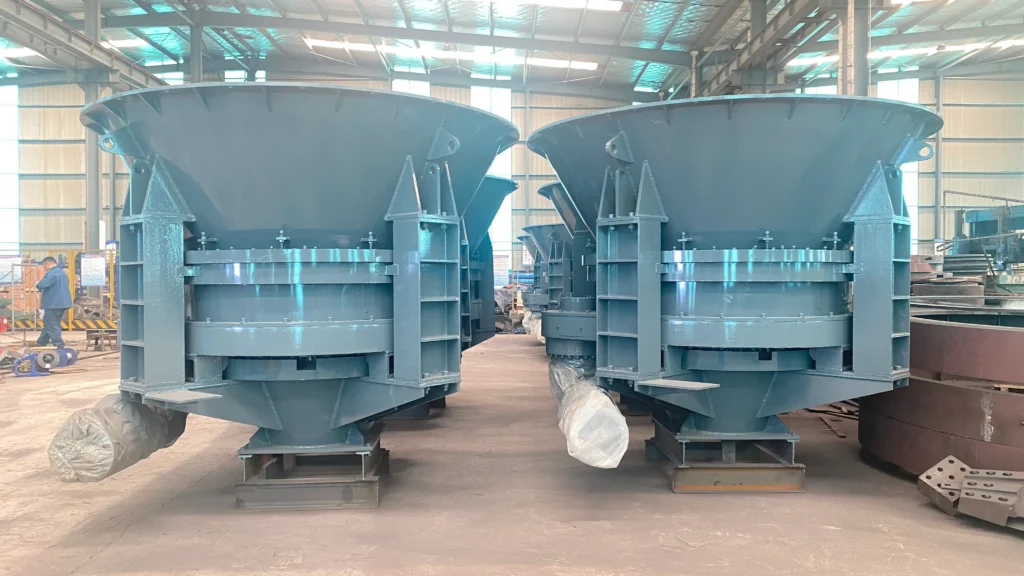
A rotary scraper system can be installed in the lower section of the silo to work on accumulated material around the internal wall and discharge area.
Unlike a one-time manual cleaning operation, mechanical clearing can be incorporated into the normal operation of the silo, depending on the material and equipment configuration.
For retrofit projects, the equipment can be designed around the existing silo dimensions and discharge arrangement.
7. Cement Silo Retrofit for Existing Plants
For an operating cement or building material plant, completely rebuilding a silo may involve significant structural work, downtime, and additional cost.
A targeted retrofit can provide another option.
The retrofit design should first identify:
- Where does the material accumulate?
- How frequently does the blockage occur?
- What is the moisture condition of the material?
- What are the silo and outlet dimensions?
- How much material needs to be discharged per hour?
- Is there sufficient space for installing mechanical equipment?
- Which components require regular inspection or replacement?
Based on these conditions, the retrofit may include improvements to sealing, internal surfaces, discharge geometry, flow-assistance equipment, or mechanical blockage-clearing equipment.
The objective is not simply to remove an existing blockage, but to improve the way the silo handles the actual powder being used by the plant.
8. A More Practical Maintenance Strategy
Once a flow problem has occurred several times, waiting for the next blockage before taking action can result in repeated production interruptions.
A better approach is to monitor early signs such as:
- increasing discharge fluctuations;
- rising motor load;
- slower material discharge;
- increasing wall buildup;
- repeated outlet blockage;
- longer cleaning intervals;
- changes in material moisture.
Inspection frequency can also be increased during Vietnam’s rainy season or when material sources change.
Small amounts of buildup are generally easier to manage than heavily compacted material that has remained inside the silo for an extended period.
Conclusion
Cement powder flow problems in Vietnam are influenced by more than the powder itself. Moisture, storage conditions, silo geometry, material buildup, and operating practices can all affect discharge performance.
For cement and fly ash handling systems, the first step is to identify where the flow problem begins rather than treating every blockage as an equipment failure.
Improving silo sealing, controlling material storage conditions, reviewing the discharge section, and adding suitable flow-assistance or mechanical clearing equipment can provide practical options for existing plants.
For facilities with recurring wall buildup, bridging, ratholing, or poor discharge, a targeted silo retrofit can improve material flow without necessarily replacing the complete storage structure.
HNMY provides customized solutions for existing silos handling cement, fly ash, coal, and other bulk materials, with retrofit designs based on silo structure, material characteristics, and operating requirements.