
Automatic Silo Blockage Prevention for Coal and Ash Handling Systems
Coal handling and ash removal systems play an important role in power plants, steel plants, and coal chemical facilities. However, maintaining stable material flow is often challenging due to moisture changes, material adhesion, and silo blockage problems.
During raw coal storage, coal proportioning, and fly ash collection processes, materials inside silos, chutes, and conveying equipment may experience wall sticking, arching, bridging, and unstable discharge. These problems are commonly caused by differences in moisture content, particle size, and material compaction characteristics.
Traditional blockage-clearing methods, including manual cleaning, air cannons, and vibration devices, can temporarily restore flow but often require equipment shutdowns and additional maintenance work. Repeated blockage problems may also increase safety risks and affect continuous operation. For this reason, many industrial plants are adopting automatic silo blockage prevention systems to improve material discharge reliability.
1. Common Silo Blockage Problems in Coal and Ash Handling Systems
Materials such as raw coal, pulverized coal, and fly ash have different flow characteristics depending on moisture content, particle fineness, and storage conditions.
Raw coal silos may experience wet coal sticking and bridging problems, especially when moisture content increases. Fly ash silos are more likely to suffer from fine powder adhesion, wall buildup, and ratholing, resulting in uneven discharge and interruptions in conveying processes.
Traditional auxiliary equipment also has limitations. Vibrators mainly loosen material near the silo wall but may cause structural stress after long-term operation. Air cannons use impact force to break material arches but cannot continuously remove thin layers of adhered material. Manual cleaning requires shutdowns and may involve confined-space safety risks.
2. Improving Material Flow from Funnel Flow to Mass Flow
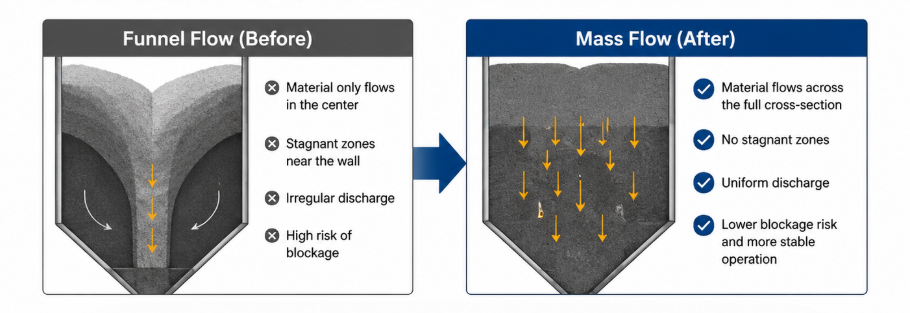
Traditional silo discharge often develops into funnel flow, where material in the center moves downward while material near the silo wall remains stagnant.
This uneven flow pattern can cause dead zones, material buildup, and unstable discharge. The vortex flow mechanism changes the internal movement of stored material and promotes a more uniform discharge pattern across the silo cross-section.
Compared with funnel flow, mass flow allows material throughout the silo section to participate in movement, helping maintain more consistent discharge conditions.
3. Working Principle of Automatic Anti-Blocking Equipment
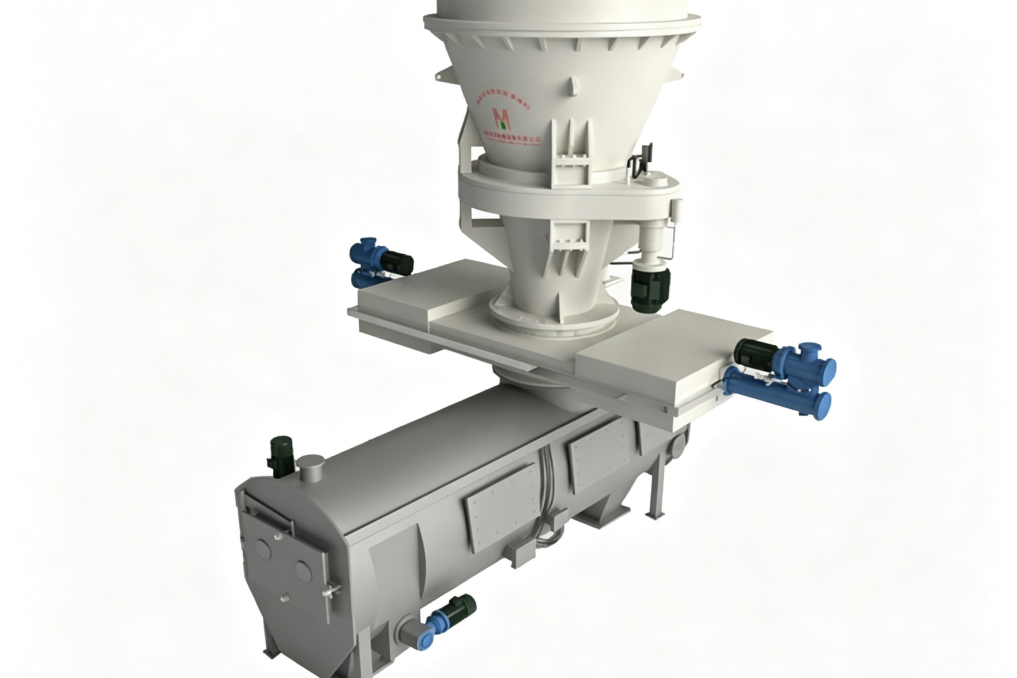
The silo anti-blocking equipment is designed for coal and ash handling applications where recurring blockage problems occur. The system uses a dynamic vortex clearing mechanism and can be installed on existing silos without major structural modifications.
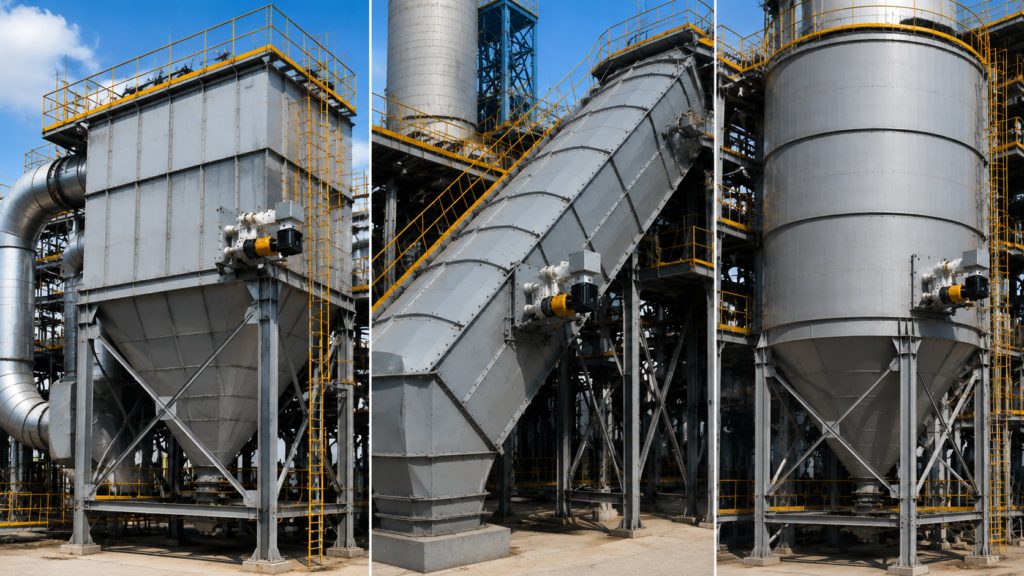
It can be applied to raw coal silos, fly ash silos, proportioning silos, and transfer chutes. The equipment operates together with the production process without requiring frequent shutdowns.
The variable-angle rotating mechanism performs continuous movement inside the silo. Through 360-degree rotation, it removes adhered material layers from the silo wall and reduces the possibility of buildup and caking.
At the same time, the vortex movement changes the original material flow pattern and helps convert single-point gravity discharge into a more uniform discharge condition. This reduces problems such as ratholing, flow channeling, and interrupted material feeding.
The system supports automatic operation, including scheduled running and signal-based start/stop control. Compared with traditional emergency clearing methods, it focuses on preventing blockage before serious accumulation occurs and reducing manual maintenance requirements.
4. Industrial Application Value
Coal conveying and ash removal systems require stable operation in power plants, steel plants, and other industrial facilities.
By improving material flow inside silos and reducing blockage frequency, automatic anti-blocking equipment helps maintain more reliable operation of conveying and proportioning systems.
The equipment is suitable for handling challenging materials with high moisture, fine particles, strong adhesion, and mixed particle sizes. It provides a practical option for reducing cleaning work, improving discharge stability, and enhancing workplace safety.
5. Applications in Coal and Ash Handling Systems
- Raw coal silos
- Pulverized coal storage
- Fly ash silos
- Dust collection hoppers
- Transfer chutes
- Proportioning silos
6. Conclusion
As industrial plants move toward more automated operation, traditional manual blockage clearing methods are becoming less suitable for continuous production requirements.
Automatic silo blockage prevention equipment based on vortex flow technology provides a reliable method for improving coal and ash handling system performance. By maintaining stable material movement and reducing manual clearing work, the system helps plants achieve safer and more consistent operation.
Related Articles
Fly Ash Silo Blockage Problems and Effective Flow Solutions
Vortex Flow Technology for Silo Blockage Prevention in Steel Plants
6 Key Reasons for Coal Bunker Blockage & Proven Practical Solutions