
In the Indian cement industry, fly ash is widely used as a supplementary material in cement and concrete production. The stable discharge of fly ash from silos directly impacts the consistency of the cement batching process and the continuity of production. Due to India’s hot and humid tropical climate, the specific characteristics of local fly ash, and the limitations of traditional storage equipment, many Indian cement plants face issues such as wall adhesion, caking, bridging, ratholing, and unstable discharge. These problems not only cause intermittent production line stoppages and uneven batching but also drive up manual maintenance costs and production losses. These issues are common challenges in fly ash storage and handling at cement plants.
1. Why Do Fly Ash Silos Block in Indian Cement Plants?
Environmental and Material Factors
One important factor is the interaction between environmental conditions and material properties. High humidity during the monsoon season in certain regions of India makes stored fly ash susceptible to moisture absorption. Over time, material accumulation can lead to caking, reducing the silo’s effective capacity and hindering normal discharge. Fly ash from different sources varies in particle size, moisture content, and flowability; material with a high proportion of fines or poor flowability is particularly prone to agglomeration and discharge difficulties.
Silo Design and Discharge Conditions
Silo geometry and discharge design can also contribute to poor material flow. The conical hopper design, discharge outlet dimensions, or silo wall conditions of some existing silos do not fully align with the actual flow characteristics of the material. High resistance to material flow makes it easy for stable arches to form above the discharge outlet, resulting in “bridging”—where the silo appears full while material flow at the bottom is cut off.
Limitations of Conventional Flow-Aid Methods
In addition, conventional flow-aid methods may have limitations under certain conditions. Local cement plants typically rely on manual clearing, wall vibrators, and air cannons to address blockages. While vibrators and air cannons can alleviate localized blockages to some extent, their effectiveness may be limited when dealing with persistent wall buildup, stable arches, or large stagnant zones. Although manual clearing can restore flow quickly, it requires downtime or human intervention, thereby increasing the burden of maintenance and safety management.
2.How Do Fly Ash Silo Blockages Affect Cement Production?
Unstable discharge from fly ash silos disrupts the automated proportioning rhythm of cement production lines, leading to imbalances in fly ash blending ratios, compromising proportioning stability, and complicating product quality control. Unplanned shutdowns caused by frequent blockages significantly reduce effective production uptime and constrain plant capacity, while material caking from long-term accumulation can impair the uniformity of downstream conveying and proportioning. Furthermore, the dust pollution and safety risks associated with manual blockage clearing increase the burden of safety management and hidden operational costs.
3.Mechanical Solutions for Fly Ash Silo Blockage
Designed for Existing Silo Retrofit Projects
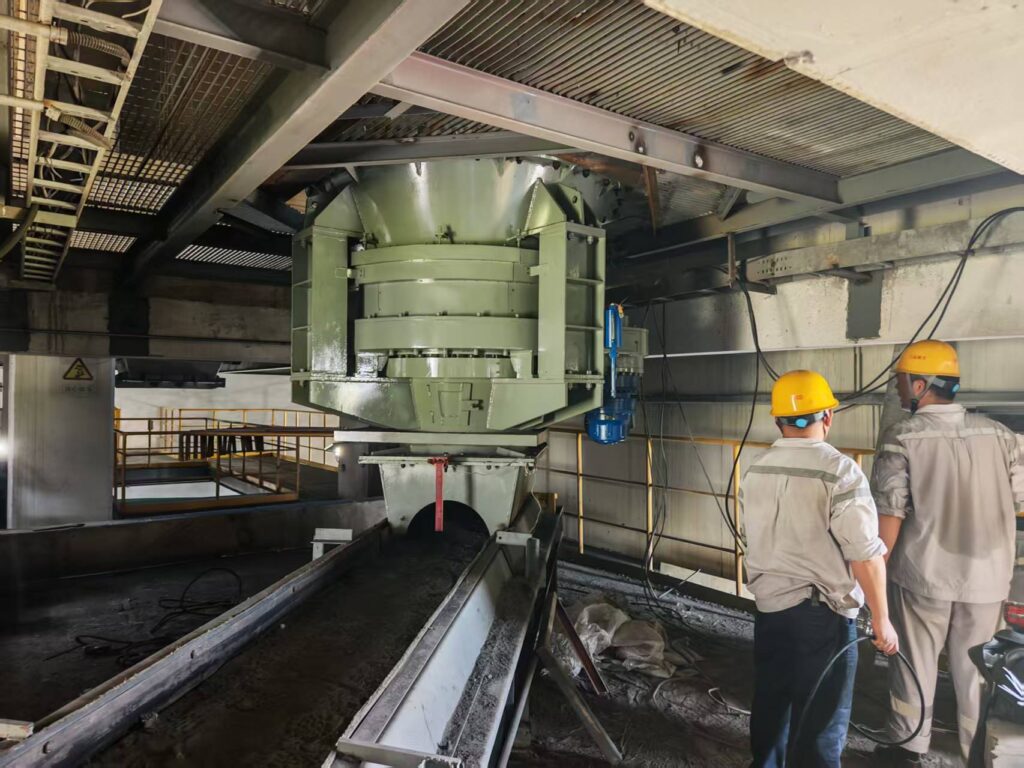
For fly ash silos that experience recurring buildup, bridging, or unstable discharge, an active mechanical flow-aid system can be considered as a retrofit solution. The equipment can be designed around the existing silo structure and site installation conditions. The equipment is designed based on existing silo structures and site installation constraints, making it suitable for retrofitting existing silos; once installed, it operates automatically according to production conditions and integrates with the production line control system.
How the Mechanical Flow-Aid System Works
The intelligent variable inclination vortex anti-blocking system employs a variable-angle rotating mechanism to continuously agitate the material within the silo and exert mechanical force on accumulations near the silo walls, thereby minimizing long-term material adhesion and preventing the formation of stable material arches. Simultaneously, dynamic vortex agitation breaks up static arches and central “ratholing” flow patterns, helping expand the active flow zone and reduce central ratholing and stagnant material areas. This can improve material turnover within the silo, reduce stagnant zones, and support more stable fly ash discharge.
The entire system supports scheduled automatic operation, start/stop synchronization with production line signals, and remote intelligent management, enabling fully unattended operation. It reduces the need for frequent manual clearing, effectively avoids losses from downtime, dust pollution, and safety hazards, and—by adapting to India’s complex climate and the specific characteristics of the powder material—helping maintain more stable material flow over extended periods of operation.
IV. Benefits of the Solution
Improved Production Continuity
Improves the continuity of fly ash discharge and reduces production interruptions caused by blockages.
Reduced Maintenance Requirements
Reduces the frequency of manual blockage clearing and repetitive maintenance tasks.
Better Silo Utilization
Minimizing material buildup on silo walls and the retention of stagnant material enhances the silo’s effective utilization rate.
Conclusion
Fly ash silo blockages rarely stem from a single cause; rather, they result from the interplay of material properties, environmental conditions, silo design, and operational practices. For silos frequently plagued by wall adhesion, bridging, and unstable discharge, merely addressing blockages after they occur is often insufficient for a long-term solution. Selecting appropriate flow-aid and anti-blockage measures based on actual operating conditions and silo design can help improve the stability of fly ash discharge.