
In sectors involving bulk material handling—such as thermal power generation, coal processing, chemicals, and metallurgy—Industrial silo blockage caused by material bridging, arching, wall adhesion and poor flowability is a common challenge in bulk material handling systems. in storage silos are commonplace. Factors such as high moisture content, uneven particle size, structural compression, and prolonged material accumulation can impede discharge, directly disrupting the continuity of the entire production line. Currently, most plants rely on either manual clearing or auxiliary clearing equipment to address silo blockages. In contrast, the automatic prevention blockage system has become a professional and reliable solution for modern industrial silo anti-blocking management. These methods differ significantly in terms of safety, operating costs, maintenance complexity, and effectiveness. A proper comparison of these approaches helps enterprises select anti-clogging solutions better suited for long-term production needs.
1. Why Manual Silo Clearing Cannot Solve Recurring Blockage Problems
Manual clearing is the traditional and most common method for unblocking silos. When issues like arching, bridging, total blockage, or wall adhesion occur, on-site personnel typically must halt the production line and machinery. They use tools to hammer, poke, or scrape the walls, or even enter the silo itself to perform the work. While this method has a low barrier to entry and requires no investment in additional equipment, its long-term use presents numerous intractable shortcomings.
First, manual clearing necessitates downtime for maintenance; frequent clogging implies frequent line stoppages, directly leading to reduced production capacity and fluctuations in power generation or production loads, thereby causing ongoing output losses. Second, working inside a silo constitutes a confined-space operation fraught with multiple safety hazards—such as material collapse, falling debris, dust-related risks, oxygen deficiency, and physical injury—making it a critical area of focus for plant safety management.
Furthermore, manual clearing addresses blockages only after they have formed, offering no preventive capability. It is difficult for workers to completely remove thin layers of adhered material from the silo walls; residual material accumulates, hardens, and causes arching to recur. This leads to a cycle of frequent clearing and rising labor costs, addressing the symptoms rather than the root cause. For long-term stable production, relying purely on manual operation can never fundamentally solve silo blockage problems, which is why more factories begin to adopt the automatic prevention blockage system for systematic anti-blocking control.
2. How Automatic Anti-Blocking Systems Prevent Silo Blockages
Driven by the shift toward factory automation and unmanned operations, the automatic prevention blockage system is gradually replacing traditional manual methods, emerging as the mainstream solution for ensuring stable material discharge in industrial silos. This professional system integrates mechanical clearing mechanisms, intelligent control modules, and adaptive operating logic to function in synchronization with the production line, eliminating the need for downtime-based interventions.
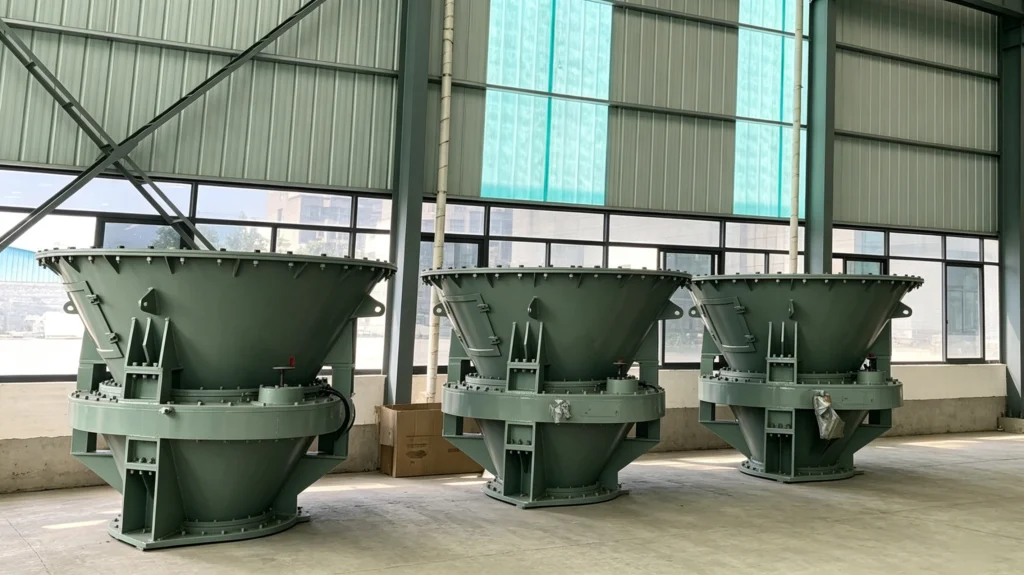
HNMY intelligent variable inclination vortex anti-blocking technology uses rotating vortex scraping and adjustable angles to prevent material accumulation before blockages occur.The defining characteristic of the automatic prevention blockage system is its focus on “prevention first and real-time clearing”. The equipment employs mechanisms such as rotating scraping, vortex agitation, and multi-angle arch-breaking to continuously clear thin layers of material adhering to the silo walls and disrupt the conditions that lead to arching, thereby addressing issues like bridging, clogging, and flow interruption at the source. Unlike manual remedial measures that only handle existing faults, this automated system operates online 24/7 and is compatible with complex material conditions, including high moisture, high viscosity, fine powders, and mixed particle sizes.
Regarding operations and maintenance, the automatic prevention blockage system supports scheduled start/stop, variable frequency speed control, and integrated linkage with plant automation systems, enabling fully unattended operation. This drastically reduces the frequency of manual entry, eliminates risks associated with confined-space work, and minimizes downtime losses caused by frequent manual clearing, ensuring uniform, stable, and continuous material discharge for industrial silos.
3. Manual Clearing vs Automatic Anti-Blocking System Comparison
| Item | Manual Clearing | Automatic Anti-Blocking System |
|---|---|---|
| Operation | Requires shutdown | Online operation |
| Safety | Confined-space risks | Reduced worker exposure |
| Maintenance | Frequent manual work | Automatic control |
| Production impact | Causes downtime | Maintains continuous flow |
| Long-term cost | High labor cost | Lower operating cost |
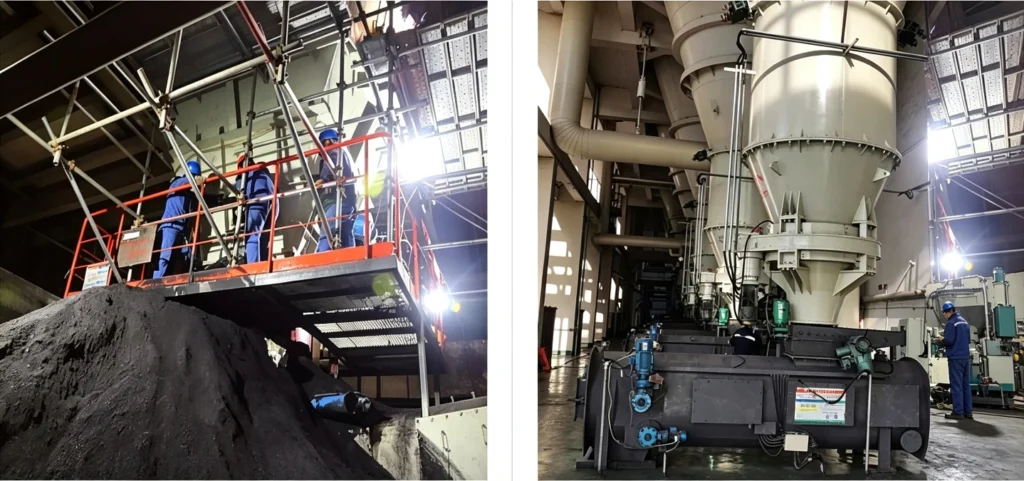
4.HNMY Intelligent Anti-Blocking Solution
HNMY provides intelligent variable inclination vortex anti-blocking machines designed for industrial silos, coal bunkers and chute systems. The equipment helps prevent material bridging, reduce downtime and improve continuous material flow.
Contact HNMY engineering team for a customized silo blockage prevention solution.