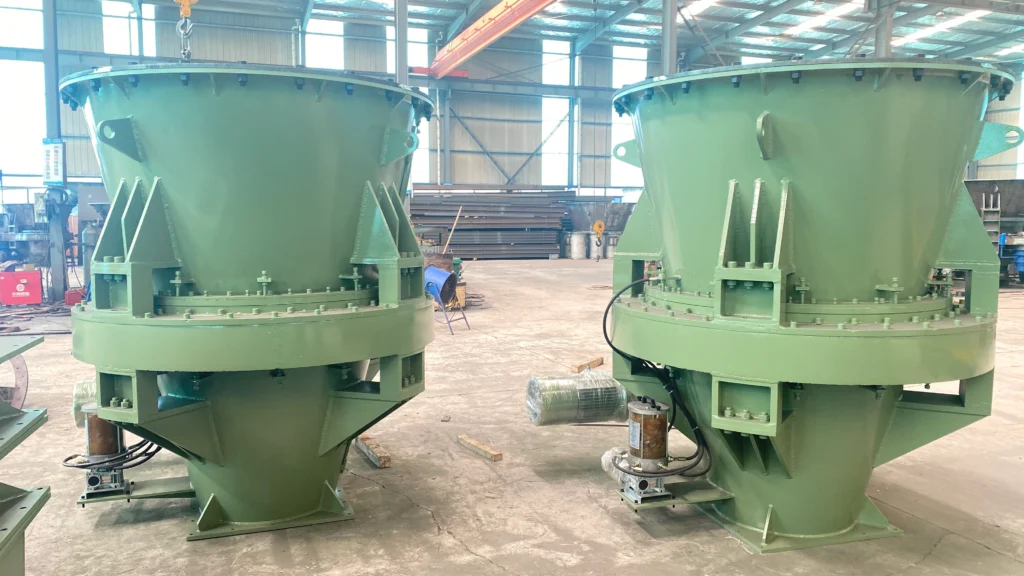
Blockages in silos and chutes are the most common and costly equipment issues in bulk material handling operations. Problems such as material buildup, arching, wall adhesion, and complete pipeline blockages frequently occur in industries such as power plants, steel mills, coal processing plants, chemical plants, and metallurgical facilities. These issues directly reduce production efficiency.
Failure to address these core problems leads to ever-increasing maintenance costs. For production managers, understanding the causes of blockages, overcoming the drawbacks of traditional clearing methods, and adopting modern automated clearing technologies are key to ensuring the long-term, stable operation of production lines.
1. Causes of Blockages in Industrial Silos and Chutes
Most on-site blockage issues result from a combination of material characteristics and equipment design flaws. High-moisture materials, sticky powders, and damp bulk materials easily adhere to the inner walls of silos and chutes. During prolonged continuous operation, sticky material accumulates in layers, progressively reducing the flow area and eventually causing sluggish discharge or even complete blockages.
Based on actual industrial conditions, the primary causes of blockages can be categorized as follows: high material moisture and stickiness, uneven discharge rates, poor structural design of silos and chutes, a tendency for materials to form arches or bridges, and the presence of “dead zones” where material accumulates inside pipes. When coarse and fine particles are unevenly mixed, a dense material arch can easily form at the discharge outlet, blocking flow and causing persistent blockages.
2. Significant Drawbacks of Traditional Manual Clearing Methods
Many factories still rely on manual methods to clear blockages in chutes and silos; however, this outdated approach has numerous shortcomings that severely hinder the safe and efficient operation of production lines.
Unavoidable production downtime: Manual clearing requires shutting down operations. Frequent shutdowns disrupt continuous production flows, reduce equipment utilization rates, and ultimately result in massive losses in production efficiency.
High safety risks for on-site personnel: Manual clearing often involves working at heights or in confined spaces, frequently in environments with high dust concentrations. Issues such as sudden material collapses, impact from falling material, and dust inhalation constantly threaten the safety of personnel, making this a high-risk operational process.
Treating symptoms rather than the root cause leads to recurring blockages: manual methods can only clear material that has already formed a blockage on the surface but fail to thoroughly remove thin, sticky layers of accumulated material on the inner walls. Residual material quickly re-accumulates, causing blockages to recur and maintenance workloads to mount, resulting in a vicious cycle of clearing and re-blocking.
3. Fully Automated Anti-Blockage System Enhances Production Line Stability
To address the various shortcomings of manual blockage clearing, fully automated anti-blockage equipment has become a standard feature in modern bulk material handling systems. Unlike reactive manual clearing, intelligent automated anti-blockage equipment focuses on “proactive prevention,” intervening before material accumulates or forms a blockage, thereby reducing blockage-related failures at the source.
The equipment can be directly installed at critical points—such as silos, hoppers, and transfer chutes—providing round-the-clock anti-blockage protection for the production line. It significantly reduces unplanned downtime and the burden of manual maintenance while ensuring uniform material discharge and stable transport, thereby guaranteeing continuous, steady production.
4. Advanced Intelligent Vortex Anti-Blockage Technology Solves Stubborn Blockage Issues
The intelligent variable-angle vortex blockage-clearing machine is built to solve tough blockage problems in silos and chutes. Unlike fixed scraping devices, it uses an adjustable vortex structure that helps create better material movement and reduce buildup.
The continuously rotating vortex scraper disrupts and breaks up solidified or stagnant material, preventing the conditions that lead to material arching or bridging. Its unique variable-angle design eliminates “dead zones” within the equipment, thoroughly resolving issues with material sticking to silo or pipe walls. This enables proactive blockage prevention—rather than reactive clearing after a failure occurs—fundamentally improving material flowability.
5. Intelligent Variable-Frequency Control Reduces Long-Term O&M Costs
The new generation of vortex anti-blockage equipment features an intelligent variable-frequency control system that supports customizable cyclic operation modes. The equipment automatically adjusts its rotational speed and operating intervals based on real-time conditions—such as material moisture, particle composition, flow rate, and environmental factors—to suit varying production states.
Its intelligent intermittent operation mode eliminates wasteful idling, reduces mechanical wear on core components, and lowers energy consumption. Thanks to automated, intelligent control, the production line can operate unattended with anti-clogging capabilities, significantly cutting long-term labor costs and equipment maintenance expenses.
6. Highly Versatile: Suitable for Complex Conditions Across Multiple Industries
This vortex-based anti-clogging device is compatible with the vast majority of bulk material handling scenarios. It can be used in coal-fired power plant coal handling systems to resolve issues like wet coal sticking to walls and chute blockages; in cement plants, it can help address cement silo discharge problems and stabilize raw material discharge; it handles ore and mineral powder blockages in mining operations; and it meets the needs for conveying and preventing clogs with sticky powders in the chemical industry.
The equipment operates reliably in harsh industrial environments—characterized by high dust, high humidity, and continuous heavy loads—and is fully compatible with standard silo and chute structures, meeting anti-clogging requirements across diverse industries.
Conclusion
Clogging in silos and chutes is a primary challenge hindering the efficient operation of bulk material handling systems. Traditional manual clearing methods are unsafe and inefficient, failing to provide a permanent solution to recurring blockages. For modern industrial enterprises, adopting automated anti-clogging equipment—specifically proven vortex-based technology—is the optimal strategy for ensuring stable, continuous production and controlling costs.
The HNMY intelligent variable-inclination vortex anti-blocking machine offers customized solutions tailored to specific site conditions, including silo structures, chute dimensions, and material properties. It effectively boosts material-handling efficiency while minimizing downtime and maintenance expenses. Don’t hesitate to get in touch with our technical team for a tailored industrial anti-clogging solution.