
Coal bunkers and material silos in power plants, cement plants, mines and chemical facilities often remain in service for many years. Over time, changes in material properties, moisture content and operating conditions can affect how reliably material moves through the silo.
Wall buildup, caking, bridging, ratholing and unstable discharge are common signs of a material flow problem. When these issues occur repeatedly, the first solution considered is often a major modification to the existing bunker or silo.
However, a complete rebuild is not always necessary.
If the existing structure is still in good condition and has sufficient capacity for the production process, an existing silo retrofit can be a practical way to improve material flow without replacing the entire storage system.
Why Do Existing Coal Bunkers Develop Blockage Problems?
Most traditional coal bunkers and storage silos depend mainly on gravity to discharge material. This arrangement can work reliably when the material has suitable flow characteristics.
The situation can change after years of operation.
Coal may contain a higher proportion of fines, moisture conditions may vary, or the material handled by the plant may change. Deposits can also accumulate on the internal walls over time.
These factors can gradually create flow problems.
Wall Buildup and Caking
Fine coal, mineral powder, cement raw materials and other cohesive materials can adhere to the internal silo wall.
At first, the buildup may be relatively small. As material continues to accumulate, however, the layer can become compacted and harder to remove.
Buildup around the lower cone or discharge area can eventually restrict the available flow path.
Bridging and Arching
Cohesive material can form an arch above the outlet.
The bunker may contain plenty of material, but little or none of it reaches the discharge opening. Operators then have to stop or reduce production to restore material flow.
Ratholing and Stagnant Material
With central discharge, material in the middle of the bunker may move while material near the walls remains stationary.
A narrow flow channel develops through the center, leaving material outside the channel inactive. If this continues for a long period, the stagnant material may compact and form additional buildup.
Unstable Discharge
Not every flow problem results in a complete blockage.
Some bunkers experience fluctuating discharge, intermittent flow or uneven feeding to the equipment below. These variations can make the operation of feeders, conveyors and downstream process equipment less stable.
Does an Existing Silo Always Need Major Modification?
Not necessarily.
Changing the hopper angle, enlarging the outlet or rebuilding part of the steel structure can be appropriate when the original silo geometry is unsuitable for the material.
However, these projects can also involve significant construction work, installation time and production disruption.
Before choosing a structural modification, it is worth determining whether the existing silo itself is still suitable.
A retrofit approach may be considered when:
- the silo structure remains serviceable;
- the storage capacity is adequate;
- the existing process layout does not require major changes;
- the main problem is material flow rather than structural damage;
- blockage occurs repeatedly in specific areas.
In these situations, the objective is not to redesign the entire silo. Instead, the retrofit focuses on improving material movement inside the existing structure.
Retrofit Solution for Existing Coal Bunkers and Silos
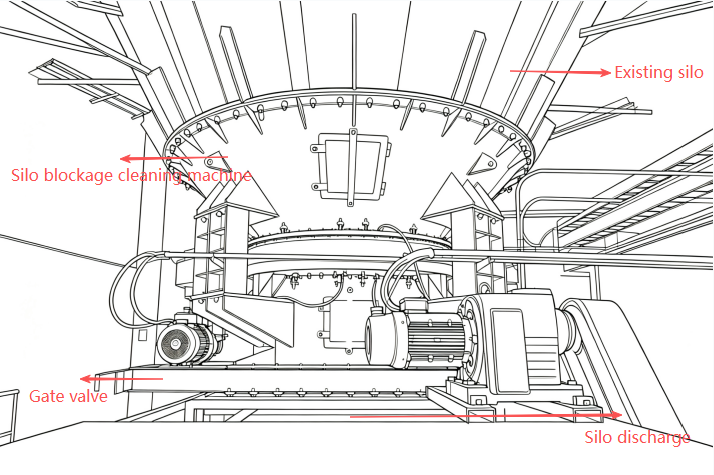
HNMY’s Intelligent Variable Inclination Vortex Anti-Blocking Machine is designed for existing silos and coal bunkers where wall buildup, stagnant material and unstable discharge are persistent problems.
The system uses a 360° rotating scraper with variable inclination. Installed inside the silo, the scraper works along the internal wall and conical hopper area.
The mechanical movement helps disturb material in areas where it tends to accumulate or remain stagnant. This provides an active flow-assistance method rather than relying only on vibration or short-duration impact.
The equipment can be configured according to the existing silo structure and the actual material-flow problem.
Retaining the Existing Silo Structure
For a serviceable coal bunker, there may be no reason to replace the entire storage vessel simply because of recurring blockage.
A retrofit allows the original silo to remain in place while an additional flow-assistance system is introduced.
This approach can be particularly useful for operating plants where replacing the bunker would involve considerable construction work or extended production interruption.
Reducing Wall Buildup
The rotating scraper provides mechanical action along areas where material tends to stick to the wall.
For fine coal, mineral powder and other materials prone to buildup, this can help reduce the accumulation associated with prolonged material stagnation.
The effectiveness depends on the material properties and silo configuration, so the actual installation should be designed according to site conditions.
Improving Stagnant Areas and Ratholing
Central flow can leave material near the silo wall inactive.
The rotating mechanism introduces movement into these areas and can help bring stagnant material back into the discharge process.
This provides a way to address one of the common causes of recurring accumulation without changing the entire silo geometry.
Automated Flow Assistance
The equipment can also be integrated with the plant’s control system.
Depending on the process requirements, operation can be linked to the production cycle, reducing the need for operators to repeatedly intervene when material flow becomes unstable.
Advantages of Retrofitting an Existing Coal Bunker
Less Structural Work
A retrofit focuses on the material-flow problem rather than rebuilding the entire bunker.
Where the existing structure is suitable, extensive steelwork or hopper reconstruction may not be required.
Reduced Production Disruption
Major structural modifications can involve cutting, welding, dismantling and installation work around the existing production system.
A targeted equipment retrofit can reduce the amount of construction required, although the actual installation method and shutdown requirements must be evaluated for each site.
Suitable for Existing Equipment
Many older bunkers remain structurally usable but no longer provide reliable material flow under current operating conditions.
In such cases, upgrading the flow-assistance system can be more practical than replacing the entire bunker.
Configuration Based on the Actual Problem
Blockage does not occur in exactly the same way in every silo.
One bunker may mainly suffer from wall buildup, while another may have bridging at the outlet or stagnant material around the cone.
For this reason, retrofit design should consider:
- material properties;
- silo dimensions;
- hopper geometry;
- outlet size;
- blockage location;
- required discharge capacity.
This allows the equipment to be configured around the actual operating problem rather than applying the same arrangement to every silo.
Where Can Existing Silo Retrofit Be Used?
The retrofit approach can be considered for different bulk material storage and handling applications, including:
- Coal bunkers in power plants
- Fly ash silos
- Cement raw material silos
- Cement powder silos
- Mineral powder silos
- Ore storage bins
- Chemical powder silos
- Transfer hoppers
- Bulk material chutes
It is particularly worth evaluating where fine, cohesive or moisture-sensitive materials repeatedly cause wall buildup or unstable discharge.
What Information Is Needed for a Retrofit Assessment?
Before selecting equipment, the actual operating conditions should be reviewed.
Material
- Material name
- Particle size
- Moisture content
- Bulk density
- Cohesion and stickiness
- Material temperature
Silo
- Diameter and height
- Hopper dimensions and angle
- Inlet size
- Outlet size
- Internal structures
- Location of existing buildup
Operation
- Normal discharge capacity
- Storage time
- Blockage frequency
- Existing flow-aid equipment
- Current control method
These details help determine whether the problem is mainly related to material characteristics, silo geometry or the existing flow pattern.
From Blockage Clearing to Continuous Flow Improvement
For a bunker that blocks repeatedly, clearing the material after every blockage does not necessarily address the reason the problem keeps returning.
If material continues to accumulate along the wall while the center remains the main flow channel, similar problems can develop again after a period of operation.
A more practical assessment looks at the complete flow path:
Material Properties → Silo Geometry → Internal Flow → Discharge
The first step is to identify where material is staying and why it is not moving. The retrofit equipment can then be positioned and configured to address those specific areas.
This approach can be more effective than simply increasing vibration or impact force.
Conclusion
An aging coal bunker or material silo does not automatically need to be demolished and rebuilt when blockage problems occur.
If the existing structure remains suitable for operation and the main problems are wall buildup, caking, bridging, ratholing or unstable discharge, an existing silo retrofit can be considered as an alternative to major reconstruction.
HNMY’s Intelligent Variable Inclination Vortex Anti-Blocking Machine provides mechanical flow assistance through a 360° rotating, variable-inclination scraper. The system can be configured for existing coal bunkers, silos and hoppers according to the material and site conditions.
For plants looking to retrofit existing coal bunker silo systems, the appropriate solution should be determined through an engineering assessment of the material, silo geometry, blockage location and operating requirements.