
Indonesia has a large and growing coal, cement, and mining sector. Across these industries, bulk materials such as raw coal, ore, mineral powder, cement raw materials, and other fine or sticky materials are commonly stored and discharged through silos, bunkers, and hoppers.
When material does not flow properly, the problem can affect the entire handling system. Poor discharge from a coal bunker can interrupt coal conveying. Blockage in a mineral powder silo can slow down downstream processing. In cement production, unstable material flow may affect batching and continuous operation.
For this reason, maintaining reliable material flow inside silos and hoppers is an important part of bulk material handling.
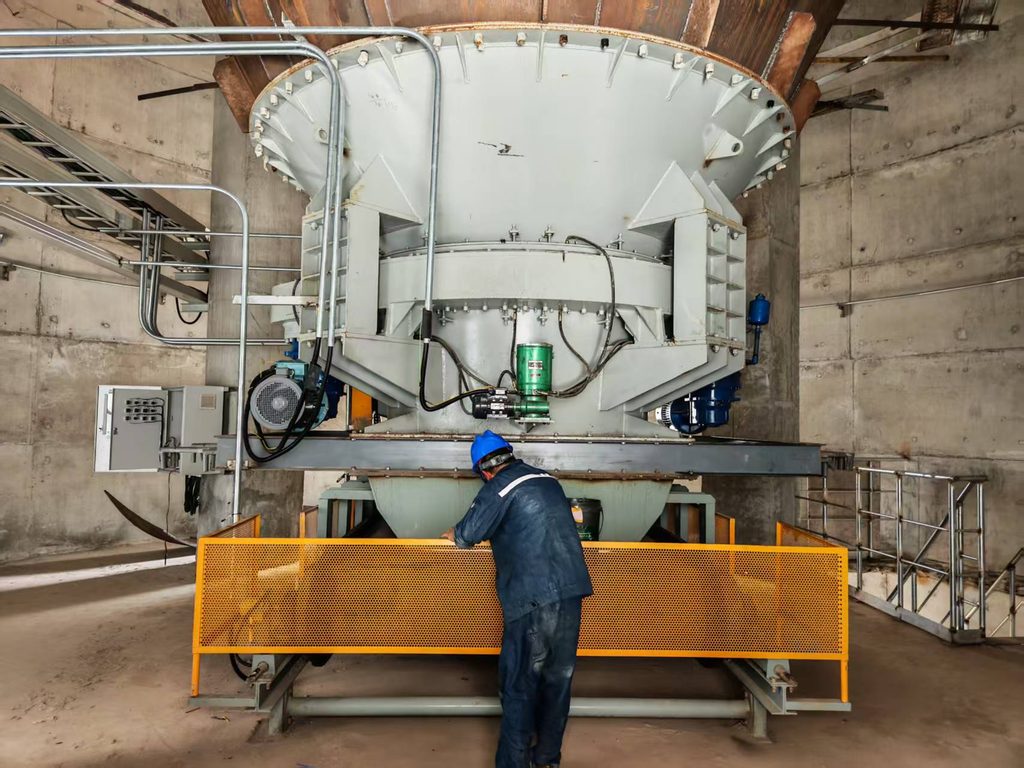
Why Silo Blockage Is a Common Problem
Indonesia’s tropical climate can create challenging conditions for bulk material storage. High humidity and long rainy periods may increase the moisture content of some materials. Fine particles and sticky materials can also adhere to silo walls during storage.
Over time, this buildup may affect the flow pattern inside the silo.
Common problems include:
- Material buildup on silo walls
- Bridging or arching above the outlet
- Ratholing, where material flows through a narrow channel while material remains around the silo wall
- Compaction and caking of stored material
- Irregular or intermittent discharge
- Complete blockage at the silo outlet or hopper
These problems are common in coal handling, cement production, mineral processing, and other bulk material systems where material properties and storage conditions can change over time.
The Impact of Repeated Silo Blockage
For continuous production facilities, a blockage is more than a simple discharge problem.
This is particularly important in coal handling systems, where coal bunker blockage can interrupt the continuous supply of fuel to downstream equipment. In more serious cases, operators may need to stop part of the system to inspect and clear the blockage.
Repeated blockage can result in:
- Unstable material discharge
- Reduced efficiency in conveying and production processes
- Unplanned maintenance and production interruptions
- Increased labor requirements for blockage removal
- Higher maintenance costs
- Safety risks when workers need to work at height or enter confined spaces
In many plants, blockage is still handled after it has already occurred. Common methods include manual cleaning, silo vibrators, and air cannons.
These methods may help restore material flow in certain situations. However, when material has accumulated on the silo wall or formed a compacted layer, temporary flow assistance may not remove the underlying buildup. As a result, the same blockage can return after the system resumes operation.
Automated Silo Blockage Prevention Solution
For materials that are prone to wall buildup, bridging, ratholing, or poor discharge, an automated anti-blockage system can provide a more continuous approach to material flow management.
The equipment can be applied to different types of storage equipment, including coal silos, mineral powder silos, cement silos, and industrial hoppers. Depending on the existing structure and operating conditions, the system can also be considered for retrofit projects.
Instead of waiting for a complete blockage before taking action, the system works inside the silo to manage material buildup and stagnant areas.
Through continuous mechanical movement and wall-cleaning action, the equipment can help:
- Reduce material accumulation on silo walls
- Break unstable bridges and compacted material
- Improve material movement toward the discharge outlet
- Reduce stagnant material zones
- Support more consistent material discharge
The purpose is not simply to clear a blockage after it occurs, but to reduce the conditions that contribute to repeated blockage.
Advantages for Coal, Cement and Mining Operations
Compared with manual blockage removal and temporary flow-assistance methods, an automated silo anti-blockage system can help reduce the frequency of maintenance and manual intervention.
Potential benefits include:
- Less material buildup and caking on silo walls
- Reduced risk of bridging and ratholing
- More stable discharge of coal, mineral powder, and cement-related materials
- Fewer production interruptions caused by repeated blockage
- Reduced need for manual cleaning inside silos
- Lower exposure to confined-space and high-risk cleaning work
- Reduced long-term maintenance requirements
The actual performance of a solution depends on material properties, moisture content, particle size, silo geometry, outlet design, and operating conditions. For this reason, the silo structure and material characteristics should be evaluated before selecting an anti-blockage system.
Applications in Indonesia’s Coal, Cement and Mining Industries
Automated silo blockage prevention equipment can be used in a range of bulk material handling applications.
Coal Mining and Coal Handling
Typical applications include:
- Raw coal storage silos
- Coal transfer silos
- Coal bunkers
- Buffer hoppers
- Coal conveying systems
For coal with high moisture content or a tendency to compact, the equipment can help improve material movement and reduce buildup inside storage equipment.
Thermal Power Plants
Coal-fired power plants rely on a stable supply of coal to the downstream feeding and combustion system.
Possible applications include:
- Raw coal bunkers
- Coal storage silos
- Feeder silos
- Coal handling and transfer systems
Reducing repeated blockage can help maintain a more stable coal supply and reduce unnecessary maintenance interruptions.
Related solution: Coal Bunker Blockage Problems in Indonesian Power Plants and How to Prevent Them
Cement and Building Materials
For plants experiencing powder buildup or poor discharge, cement silo blockage solutions can help improve material flow and reduce repeated cleaning requirements.
Applications may include:
- Raw material silos
- Cement powder silos
- Blending and batching silos
- Storage hoppers
- Material discharge systems
Where powder buildup or poor discharge affects production, a mechanical anti-blockage system can be considered as part of the overall material flow solution.
Related solution: Cement Silo Material Buildup: Root Causes and Prevention Methods
Mining and Mineral Processing
Mining and mineral processing operations often handle materials with different particle sizes, moisture levels, and flow characteristics, making mining hopper blockage solutions an important consideration for reliable material handling.
Typical applications include:
- Ore storage silos
- Mineral powder silos
- Fine powder storage equipment
- Transfer hoppers
- Processing line buffer hoppers
The equipment can be adapted according to the silo structure and material handling requirements.
Related solution: Bulk Material Flow Problems in Indonesian Mining Operations
Choosing the Right Silo Blockage Solution
There is no single solution suitable for every silo blockage problem.
Before selecting equipment, several factors should be considered:
- Type of material
- Moisture content
- Particle size
- Material flow characteristics
- Silo diameter and height
- Hopper angle and outlet size
- Existing blockage locations
- Required discharge capacity
- Whether the equipment is being installed in a new or existing silo
A proper evaluation of these conditions helps determine whether mechanical cleaning, flow assistance, structural modification, or a combination of solutions is the most suitable approach.
Conclusion
Reliable material flow is essential for coal handling, cement production, and mining operations in Indonesia.
High humidity, moisture-sensitive materials, fine powders, and long storage periods can contribute to wall buildup, bridging, ratholing, and unstable discharge. When these problems occur repeatedly, they can increase maintenance requirements, interrupt production, and create additional safety risks.
An automated silo anti-blockage system provides a more proactive approach by addressing material buildup and flow problems inside the silo. When properly matched to the material and silo structure, it can help improve discharge consistency, reduce repeated manual cleaning, and support more stable operation of bulk material handling systems.
For coal, cement, mining, and other bulk material handling projects in Indonesia, the most suitable solution should be selected based on the actual material characteristics and operating conditions of the silo or hopper.