
India’s mining and mineral processing industry handles a wide range of bulk materials, including iron ore, bauxite, coal, mineral powders, tailings and fine particles generated during crushing, screening, washing and grinding.
Throughout these processes, silos, hoppers and chutes are used to store and transfer material between different stages of production. When material does not discharge as expected, the problem can quickly affect the equipment downstream.
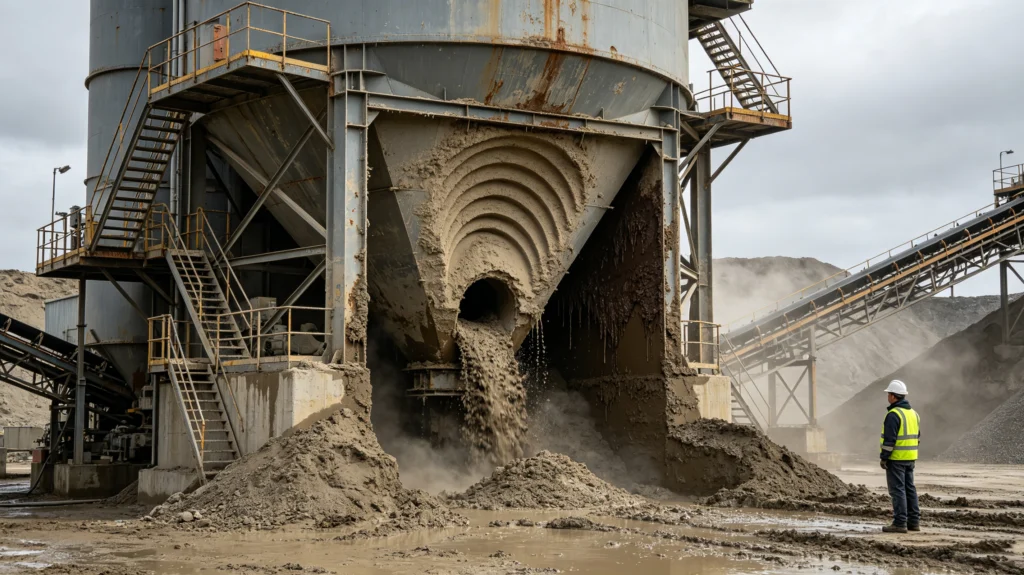
For plants handling fine, cohesive or moisture-sensitive materials, mineral silo blockage can become a recurring operating problem. Material buildup on silo walls, caking, bridging, ratholing and uneven discharge can reduce usable storage capacity and make material feeding less predictable.
For mining operators, the challenge is therefore not simply clearing a blockage after it occurs. The more practical question is how to keep material moving through the silo consistently during normal operation.
Common Bulk Material Flow Problems in Mineral Processing
The flow behavior of mineral materials can change considerably as ore moves through crushing, screening, washing, grinding and beneficiation.
Particle size, moisture content, clay content and bulk density may all change from one process stage to another. As a result, the same type of silo may experience different flow problems depending on the material being stored.
Wall Buildup and Caking
Fine mineral powders and clay-containing materials can adhere to silo walls, particularly when moisture levels increase.
A thin layer of buildup may initially have little effect on production. However, if material continues to accumulate, the layer can become compacted and reduce the effective space available for material flow.
Over time, buildup around the lower cone or near the outlet can also restrict the discharge path.
Bridging and Arching
Cohesive materials may form a stable arch above the discharge opening.
When this happens, material remains inside the silo but does not move through the outlet. Operators may see a full or partially full silo while little or no material is being discharged.
This type of blockage is particularly troublesome because restoring flow from outside the silo does not always remove the material that has accumulated elsewhere inside the bin.
Ratholing and Uneven Discharge
Another common flow pattern is ratholing.
Material in the central area moves toward the outlet while material close to the silo walls remains stationary. The result is a narrow flow channel surrounded by stagnant material.
This can cause several problems:
- reduced effective storage capacity;
- inconsistent feed to downstream equipment;
- long residence times for stagnant material;
- additional wall buildup and compaction;
- greater difficulty when the silo eventually needs to be emptied.
Hopper and Chute Blockage
Flow problems are not limited to storage silos.
Transfer hoppers and chutes can also accumulate fine or sticky material on their internal surfaces. Once buildup becomes thick enough, the opening available for material flow becomes smaller and the risk of blockage increases.
In a continuous mineral processing plant, a blockage at one transfer point can interrupt material movement through several downstream processes.
What Causes Silo Blockage in Mining Applications?
There is rarely a single reason for a silo blockage. In most applications, the problem develops from a combination of material characteristics, moisture conditions, silo geometry and operating conditions.
Material Characteristics
The properties of the stored material have a major influence on flowability.
After crushing and grinding, the proportion of fine particles may increase considerably. Materials containing clay or other cohesive components can become more difficult to discharge, particularly when the moisture content changes.
Particle size distribution is also important. A silo handling relatively free-flowing coarse material may behave very differently when the same process begins producing a greater proportion of fines.
Moisture and Seasonal Conditions
Moisture is another important variable for mineral processing plants.
During India’s monsoon season, changes in humidity and rainfall can affect the moisture content of stored materials. Fine powders and clay-rich materials may become more cohesive as moisture increases, making wall adhesion, caking and buildup more likely.
This does not mean every Indian mine will experience the same conditions, but plants handling moisture-sensitive materials may need to account for seasonal changes when evaluating silo flow problems.
Silo Geometry and Flow Dead Zones
Silo geometry also plays an important role.
Discharge opening size, hopper angle, wall condition and internal configuration can all influence how material moves through a bin. If certain areas receive little or no material movement, stagnant zones can develop.
Once material remains in these areas for a long period, it may compact or adhere to the wall, making the original flow problem progressively harder to manage.
Limitations of Conventional Blockage Clearing Methods
Vibrators, air cannons and manual cleaning are commonly used to restore material flow.
These methods can be useful in particular applications, but they generally address the immediate symptom rather than continuous material movement inside the silo.
For example, an air cannon produces a short-duration impact, while a vibrator applies mechanical vibration to the structure. Neither method necessarily removes material that has accumulated along the entire silo wall or in areas outside the main flow channel.
Where blockages occur repeatedly, it is worth considering whether the silo needs a more continuous flow-assistance approach rather than relying only on emergency clearing.
How Does Mineral Silo Blockage Affect Mining Production?
A silo is often positioned between important stages of a mineral processing plant. Its performance therefore affects more than the storage vessel itself.
When discharge becomes unstable, downstream equipment may receive an inconsistent material feed.
Depending on the process, this can result in:
- fluctuating crusher feed;
- reduced screening throughput;
- unstable material supply to beneficiation equipment;
- intermittent conveyor operation;
- additional production interruptions;
- more frequent maintenance and manual cleaning.
The cost of a blockage is also not limited to the time spent removing the material. Repeated interruptions can affect production scheduling and require operators and maintenance personnel to respond to the same problem several times.
For this reason, improving the stability of silo discharge can be an important part of improving overall material-handling reliability.
A Proactive Approach to Mineral Silo Blockage Prevention
For silos that repeatedly experience wall buildup, bridging or ratholing, a proactive flow-assistance system can be considered instead of relying solely on blockage clearing after a problem occurs.
HNMY’s Intelligent Variable Inclination Vortex Anti-Blocking Machine uses a 360° rotating scraper with variable inclination to work inside the silo.
The scraper is designed to follow the internal wall and cone area, providing mechanical movement in areas where mineral material tends to remain stagnant or accumulate.
Rather than relying on a single impact to break an existing blockage, the system is intended to assist material movement and reduce the conditions that allow buildup and stagnant zones to develop.
Retrofit for Existing Mining Silos
Replacing an existing silo is not always practical for an operating mine.
A new silo can involve structural modifications, installation work and significant downtime. For this reason, retrofit solutions can be attractive when the existing vessel is structurally suitable but has persistent material-flow problems.
HNMY’s system can be configured for existing silo retrofit applications, allowing the original storage structure to remain in service while adding an active flow-assistance mechanism.
The actual retrofit arrangement depends on the silo dimensions, outlet configuration, material characteristics and available installation space.
Mechanical Assistance for Wall Buildup
When sticky or fine mineral material remains against the wall for extended periods, it can gradually build up and compact.
The rotating scraper provides continuous mechanical action along the internal surface, helping to limit the accumulation of material in these areas.
This approach is particularly relevant where conventional vibration has not provided sufficient control of persistent wall buildup.
Addressing Stagnant Zones and Ratholing
Ratholing occurs when material in the central flow channel moves while material near the walls remains stationary.
A mechanical flow-assistance system can introduce movement into areas outside the main discharge channel.
By reducing prolonged stagnation, the system can help improve material participation in the discharge process and reduce the accumulation associated with stagnant zones.
The expected result depends on the material and silo geometry, so engineering assessment is recommended before installation.
Automated Operation
For continuous mineral processing plants, manual intervention is often undesirable.
The anti-blocking machine can be integrated with the plant’s operating controls and configured to run according to the production process.
This allows the system to provide regular flow assistance without requiring operators to repeatedly enter or manually clean the silo.
Applications in Mining and Mineral Processing
A mineral silo blockage solution may be considered for a range of bulk material handling applications, including:
- Raw ore storage silos
- Mineral powder silos
- Beneficiation material silos
- Tailings powder storage
- Crushing surge bins
- Mineral processing hoppers
- Transfer hoppers
- Fine-material chutes
- Powder storage and discharge systems
The suitability of any anti-blocking system depends on the actual material and equipment conditions.
Important parameters include:
Material: particle size, moisture, bulk density, cohesion and stickiness
Silo: diameter, height, cone angle, outlet size and internal configuration
Process: feeding rate, storage time, discharge frequency and operating temperature
Site: available installation space, existing equipment and control system
A site-specific evaluation should be carried out before selecting the final equipment configuration.
From Emergency Clearing to Better Material Flow
If a silo repeatedly experiences blockage, simply increasing the force used to clear the material may not address the underlying flow pattern.
A more useful way to evaluate the problem is to look at the relationship between:
Material Characteristics → Silo Design → Flow Pattern → Discharge Performance
For example, a change in moisture content may increase material cohesion. That can increase wall buildup, which reduces the available flow area and encourages more material to remain stagnant. Over time, the accumulation can contribute to bridging or unstable discharge.
Understanding this sequence makes it easier to determine whether the problem should be addressed through material conditioning, silo modification, flow assistance, or a combination of approaches.
For Indian mining and mineral processing plants handling fine, clay-rich or moisture-sensitive materials, this approach can provide a more practical way to evaluate recurring mineral silo blockage.
Conclusion
Silo blockage in mining and mineral processing is usually the result of several factors acting together. Material properties, moisture variation, silo geometry and operating conditions can all influence how reliably a material moves through a storage bin.
When wall buildup, bridging, ratholing or unstable discharge occurs repeatedly, the solution should not necessarily be limited to clearing the blockage each time.
For suitable applications, retrofitting an existing silo with an active mechanical flow-assistance system can help reduce material accumulation and improve discharge stability while minimizing the need for frequent manual intervention.
For mining and mineral processing operations in India, the right mineral silo blockage solution should ultimately be selected according to the actual material, silo configuration and production requirements.