
Silo discharge problems can reduce discharge efficiency and interrupt cement plant operations. Such problems may lead to production interruptions, inaccurate batching, increased manual cleaning, and higher maintenance costs. Therefore, improving cement powder flow and silo discharge efficiency is essential for maintaining stable production and reducing operational costs.
1.What Are the Common Silo Discharge Problems?
1. Bridging and Arching
2. Ratholing
3. Material Buildup on Silo Walls
4. Caking and Poor Flowability
5. Intermittent or Uneven Discharge
6. Restricted Silo Outlet Flow
2.What Causes Silo Discharge Problems?
Fine cement powder readily absorbs atmospheric moisture; once damp, its adhesiveness increases significantly, and long-term accumulation on silo walls leads to the formation of hard, caked layers. Traditional silos rely solely on gravity for discharge, making them prone to forming stable material arches and experiencing “ratholing” (or “pipe flow”)—where only a small amount of material in the center flows out, while the surrounding powder remains static, becoming compacted and caked over time.
Other factors can also contribute to silo discharge problems, including high resistance in the silo cone, rough inner walls, prolonged storage times, and humid conditions. These factors can increase wall friction, material adhesion, compaction, and caking, further reducing powder flowability.
3. Silo Discharge Problems: Effective Solutions
1. Improve Moisture Protection
Fine cement powder is highly susceptible to moisture-induced caking. Strengthening the sealing of the silo roof, access hatches, and dust collection ports minimizes the ingress of external moisture and maintains a dry internal environment. This significantly reduces the likelihood of wall adhesion and caking at the source, thereby stabilizing material flowability.
2. Reduce Wall Friction and Material Adhesion
Treating the inner surface of the silo’s conical section to make it smooth and wear-resistant reduces the frictional and adhesive forces between the powder and the wall. This prevents long-term material buildup and adhesion, allowing the material to flow downward more smoothly and evenly.
3. Use a Silo Flow-Aid or Anti-Blocking System
Vibrators and air cannons can be effective for certain material-flow conditions, but their performance may be limited when persistent wall buildup, severe caking, or recurring arching is involved. In some applications, excessive vibration may also contribute to material compaction or localized caking.
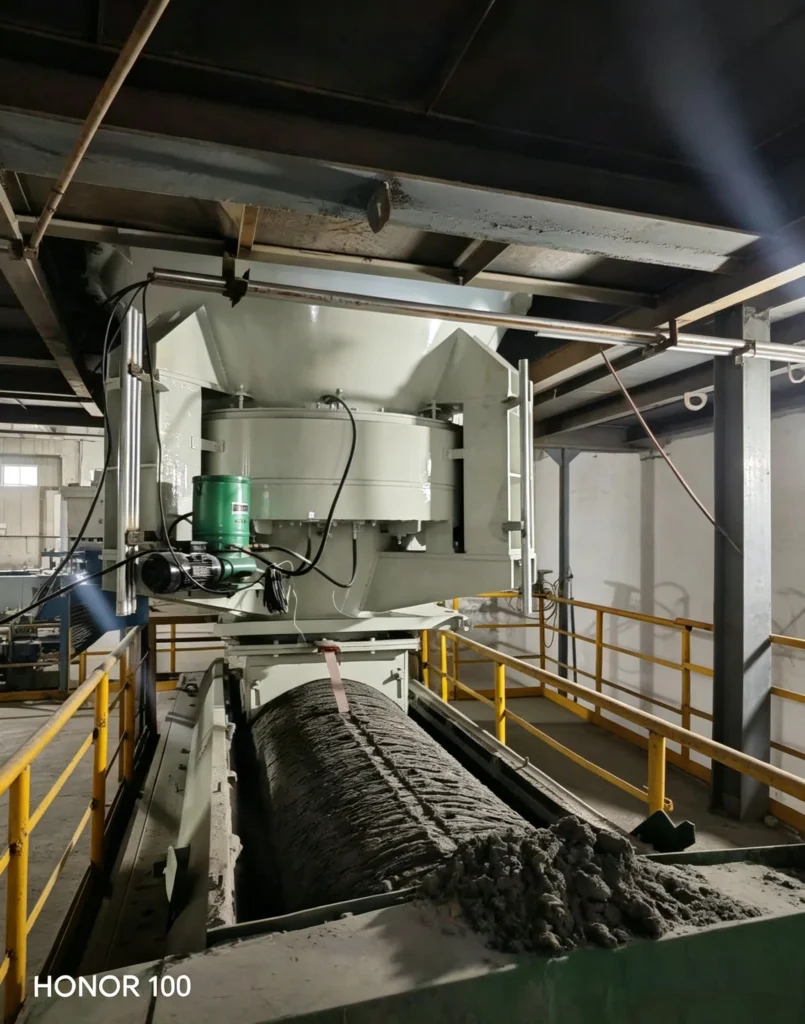
The Intelligent Variable Inclination Vortex Anti-Blocking Machine can be used for existing silos suffering from recurring discharge problems, wall buildup, bridging, or ratholing. The equipment operates continuously online without requiring system shutdowns.Its 360° rotating scraper continuously sweeps along the inner silo wall, removing accumulating material and disrupting the conditions that can lead to arching and bridging. By maintaining material flow along the silo wall, the system helps reduce buildup, ratholing, flow interruption, and uneven discharge.
4. Optimize Cement Powder Storage and Turnover
Strictly implement a “First-In, First-Out” (FIFO) policy to prevent the long-term stagnation and accumulation of cement powder. This minimizes material compaction and solidification, preserves powder activity and flowability, and reduces the likelihood of clogging.
4.How to identify your own issues
Silo discharge problemTypical symptomPossible causeSuitable solution
| Silo discharge problem | Typical symptom | Possible cause | Suitable solution |
|---|---|---|---|
| Bridging | No material discharge | Arch formation | Mechanical flow assistance |
| Ratholing | Material flows mainly through the center | Poor flowability / wall friction | Flow-aid system |
| Wall buildup | Material sticks to silo wall | Moisture / adhesion | Wall flow assistance |
| Caking | Hardened material blocks flow | Moisture / long storage | Preventive flow control |
| Intermittent discharge | Unstable material flow | Buildup / arching | Continuous flow assistance |
5.Why Do Silo Discharge Problems Keep Coming Back?
Cement powder gradually builds up on silo walls, reducing the effective flow area and disrupting material flow. Over time, this can lead to arching, bridging, rat-holing, and recurring blockage.
Material buildup → Reduced flow area → Unstable flow → Arching/Bridging → Blockage
Simply clearing the blockage does not address the underlying buildup. Preventing wall accumulation and maintaining stable material flow are key to reducing recurring silo blockages.
6.How to Choose a Solution for Silo Discharge Problems
| Factor | Why It Matters |
|---|---|
| Silo diameter | Determines coverage and installation arrangement |
| Outlet diameter | Affects discharge capacity |
| Cone angle | Influences material flow |
| Cement properties | Determine flowability and adhesion |
| Storage time | Affects compaction and caking |
| Moisture conditions | Influence material buildup |
| Existing equipment | Determines whether an upgrade or additional system is needed |
7. Benefits of Improving Cement Silo Discharge
Through systematic optimization, including the installation of automated silo anti-clogging and flow-aid equipment, cement silos can achieve more continuous, stable, and uniform discharge. These systems can reduce shutdowns and manual unclogging while improving powder discharge efficiency and batching accuracy. They can also help lower labor costs, reduce material waste, and improve the overall automation level of the production line.
Conclusion
Low discharge efficiency and recurring clogging of cement powder are persistent pain points for most building material production lines. Relying solely on traditional equipment and manual cleaning cannot fundamentally solve these issues. For plants experiencing recurring arching, rat-holing, wall buildup, or intermittent discharge, an automatic anti-clogging and flow-aid system can provide a more consistent approach to maintaining stable silo discharge and reducing recurring flow problems. For existing cement silos, retrofit solutions can also be considered when replacing the entire silo is impractical.